Moving Checklist Printable
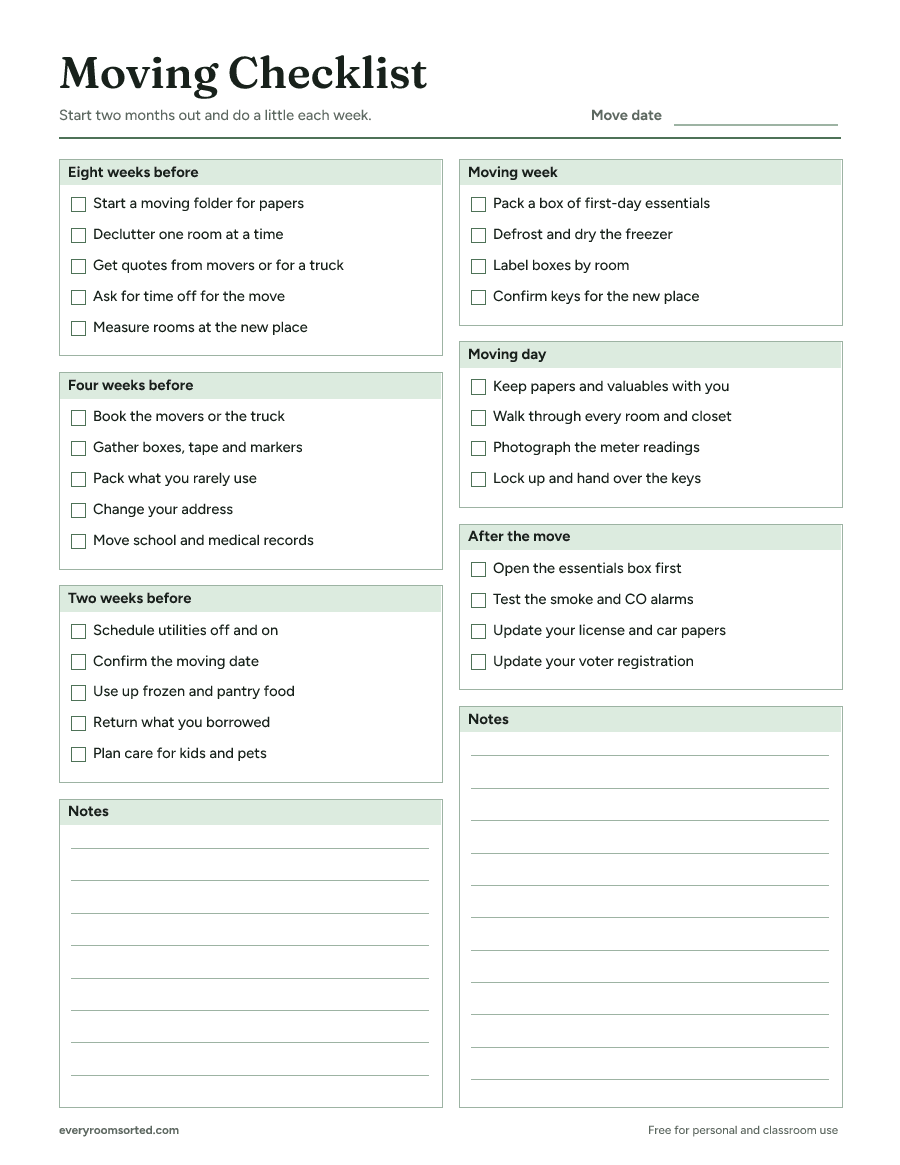
A one-page moving checklist that counts down from two months out to your first days in the new home, with a short list for each stretch, so the move happens a little at a time.
Published
Download the free PDF
One US Letter page with light lines that are easy on ink. No sign-up, no email.
Download the PDFFree for personal and classroom use. Please share a link to this page rather than the file. Terms of use
Who it’s for
This moving checklist is for anyone packing up a home: a first-time buyer, a family changing school districts, a grown kid leaving home or a renter moving across town. It turns the move into a countdown from eight weeks before the move to your first days in the new place, with a short list for each stretch.
The same page works for a move down the street or across the country. A longer move adds some paperwork, but the order of the jobs stays the same.
What’s on the page
- A countdown: 6 stretches, from “Eight weeks before” to “After the move,” with 27 jobs to tick in all.
- Early jobs: the slow ones that need lead time, like “Start a moving folder for papers” and “Get quotes from movers or for a truck.”
- The last stretch: what to do once you’re in, from “Open the essentials box first” to “Update your voter registration.”
- Move date: a line at the top for the day itself, so every stretch has a date to count back from.
How to use it
- Print a copy as soon as you know the date and write the move date on the line at the top.
- Count back from the move date and put each stretch on your calendar, so “Four weeks before” becomes a real week.
- Keep the page in your moving folder with the quotes, receipts and lease or sale papers.
- Do a few jobs each week and tick them as you go, rather than saving them all for the last weekend.
- Carry it on moving day. The last two stretches are the ones you need with the keys in your hand.
Why a countdown works
A move feels huge because every job seems urgent at once. Spread over two months, each week asks for only a few things, and most of them are quick.
The order matters too. Some jobs can’t wait: movers and trucks book up, time off needs approval and records take a while to arrive. Others only make sense late, like defrosting the freezer or packing the box you’ll open first. The countdown puts each job where it fits.
A ticked list also helps when the house is full of boxes. You can see what’s done, so you stop carrying the whole move in your head.
What each stretch covers
Here is what each part of the countdown asks for, and how to keep it simple.
Eight weeks before
Start with the papers and the stuff. A moving folder (a plain folder or a large envelope) keeps quotes, receipts, and lease or closing papers in one place.
Then declutter one room at a time. Every item you let go of now is one you don’t pack, carry or unpack. If you want a plan for it, the declutter challenge gives you one small spot a day.
Compare a few movers, or a truck you drive yourself, and ask for the time off early. Measure the rooms at the new place, so you know which furniture fits before it goes on the truck.
Four weeks before
Book the movers or the truck once you’ve compared quotes, then gather boxes, tape and markers. Pack what you rarely use first: off-season clothes, guest bedding, books, decor and the back of the closets.
This is also the stretch for paperwork. Change your address with the post office and the places that send you mail, and ask schools and doctors’ offices to send records ahead or give you copies to carry.
Two weeks before
Schedule the utilities (power, water, gas, trash and internet) to stop at the old place and start at the new one, so you arrive to lights and running water. Confirm the moving date with the movers, the building and anyone helping you.
Plan meals around what’s in the freezer and pantry, so less food has to travel. Return anything you borrowed, and set up care for kids and pets on moving day, so they’re safe and out from under the boxes.
Moving week
Pack a box of first-day essentials: sheets, towels, toilet paper, soap, chargers, medicine, a few tools, snacks and a change of clothes for everyone. Move it yourself, in the car, so it’s never stuck behind the sofa.
Empty and defrost the freezer early in the week, so it’s dry by the time it goes on the truck. Label every box with the room it goes to, and check how and when you’ll get the keys to the new place.
Moving day
Keep papers, medicine, valuables and your phone with you, not in the truck. Before you leave, walk through every room and closet and open every cabinet: that’s where forgotten things hide.
Photograph the meter readings so the final bills match, then lock up and hand over the keys. If you’re handing the home over to someone, the move-out cleaning checklist covers the clean before that last walk-through.
After the move
Open the essentials box first, make the beds and leave the rest for tomorrow. Test the smoke and carbon monoxide alarms in the new home before the first night, and if one doesn’t sound, replace its batteries or the alarm.
Then update your driver’s license, your car’s registration and your voter registration with the new address. Each state sets its own rules and deadlines for these, so look them up soon after you arrive.
Across town or out of state
A local move keeps most of your accounts the same. You still change your address, move the utilities and update your license, but the paperwork stays light.
An out-of-state move adds a new license, a new car registration and voter registration in the new state, and often new doctors, schools and insurance. Start the record requests early, since there are new offices on both ends.
For a long move, pack a small bag of what you’d need if the truck arrives a few days after you: clothes, medicine, chargers and important papers.
Fitting it to your move
A first place of your own
Moving out of a family home often means leaving with very little furniture. Use the first apartment checklist beside this one to see what you’ll need on the other end, and buy it after you’ve measured the rooms.
A big family
Give each person a box color or a letter, and let older kids pack and label their own rooms. The essentials box may need to be a few boxes, one per person.
Kids and pets
Pack the kids’ rooms last and unpack them first, so bedtime feels familiar sooner. On moving day, keep pets in a quiet room with the door closed, or with a sitter, and put a sign on the door so no one lets them out.
A move on short notice
If you have less than two months, start at the stretch that matches your date and fold the earlier jobs into it. Book the movers or the truck first, because it’s the job with the least room to bend, then declutter as you pack.
When the plan slips
Something always runs late. If a stretch doesn’t get done, carry its jobs into the next one and keep going; the countdown still works with a few extras each week.
Protect the jobs that can’t move: the truck or the movers, the utilities, the keys and the first-day box. Everything else can wait until you’re unpacked.
Tips for a smoother move
- Take a photo before you unplug anything, so the cables go back the right way.
- Pack heavy things in small boxes and light things in big ones, so every box can be lifted.
- Keep screws and small parts in a labeled bag taped to the furniture they came from.
- Write the room on two sides of every box, so you can read it when the boxes are stacked.
- Use what you have. Towels, bedding and suitcases pad and carry things as well as new supplies do.
Save this for later
Pin it to a board so it's there when you're ready to start.
Save to Pinterest(opens in a new tab)Frequently asked questions
When should I start a moving checklist?
About two months before the move gives you time to declutter, compare movers and book a date without rushing. With less time, start at the stretch that matches your date and fold the earlier jobs into it.
What do I need to update when I move to another state?
Your address, your driver's license, your car's registration and your voter registration, along with school and medical records. Each state sets its own rules and deadlines, so look up the motor vehicle and election offices in your new state soon after you arrive.
What goes in a first-day essentials box?
Whatever you need before the rest is unpacked: sheets, towels, toilet paper, soap, chargers, medicine, a few tools, snacks and a change of clothes. Label it clearly and move it yourself, so it never ends up behind the furniture in the truck.
Does this checklist work for a move across town?
Yes. A local move has less paperwork, but the packing, the utilities, the address change and the keys are the same. If the move is small, shorten the countdown and do the early jobs in a few longer sessions.
More free printables
First Apartment Checklist Printable
A one-page first apartment checklist that walks you from the first viewing to a settled first week, stage by stage, with the few things to have ready for the first night.
A one-page move-out cleaning checklist for an empty home, room by room, from the inside of the oven to the dated photos you take before you hand over the keys.
Apartment Essentials List Printable
A one-page apartment essentials list, room by room: the everyday things a new home needs, to tick off as you buy them or find one you already own.