30-Day Declutter Challenge Printable
A one-page declutter challenge for a month: one small spot to clear each day, easiest first, so the whole house gets a pass in short sessions.
Published
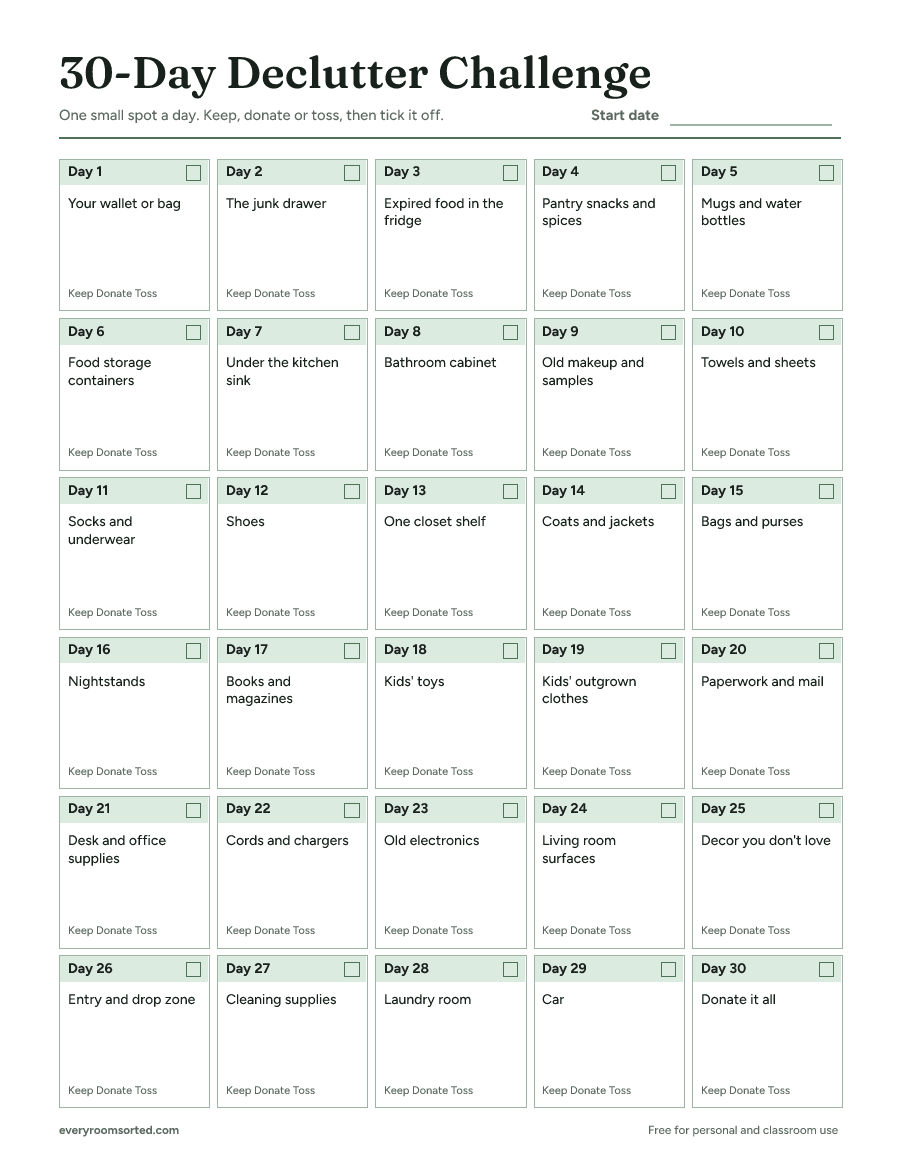
Download the free PDF
One US Letter page with light lines that are easy on ink. No sign-up, no email.
Download the PDFFree for personal and classroom use. Please share a link to this page rather than the file. Terms of use
Who it’s for
This challenge is for anyone who wants a lighter house but can’t give up a whole weekend to get there. It hands you one small spot to clear each day for 30 days, so the work fits between school pickup and dinner.
It’s a different tool from the declutter checklist, which lists what to look for room by room. The checklist suits a big push on one room. The challenge is a day-by-day plan that keeps you moving in small steps until the whole house has had a pass.
What’s on the page
- 30 squares, one for each day, with the day’s number and one spot to clear, from your wallet or bag on the first day to “Donate it all” on the last.
- Keep, Donate, Toss printed at the foot of every square, so you can circle the piles you used that day.
- A box to tick in the corner of each square once the spot is done.
- A start date at the top, so you can see when you began and how far you’ve come.
How to use it
- Write your start date and put the page where you’ll see it, like the fridge or the inside of a closet door.
- Set up one donate box by the front door and keep a trash bag handy for the whole month.
- Clear the day’s spot in one short session: take everything out, sort each item, then put the keepers back.
- Deal with the piles the same day. Trash goes out, donations go in the box by the door.
- Tick the square and stop. Tomorrow has its own spot.
Why one spot a day works
A big decluttering day asks for energy and a free afternoon, and both run out fast. A single drawer or shelf takes a short session, so you can finish it even on a busy day, and finishing is what keeps you going.
The spots run easiest first. Your wallet and the junk drawer hold few hard decisions, so the first days build the habit before you reach closets, paperwork and the kids’ things.
The progress is easy to see, too. Every ticked square is a spot that stays clear, and by the last row the whole house has had one pass.
Keep, Donate, Toss
Every square ends with the same three words. Each thing you pick up goes into one of them, and nothing goes back on the shelf undecided.
Keep
Keep what you use, what works and what you’d choose again. Put the keepers back neatly before you finish, with the things you reach for most at the front.
If the keepers won’t fit the space, sort them once more. The size of the drawer or shelf sets the limit, not how much you happen to own.
Donate
Donate what’s clean, whole and working: clothes in good shape, toys with all their pieces, mugs without chips. Drop each day’s donations straight into the box by the door, so they leave the room right away.
Check what your local donation center accepts before the drop-off. Anything stained, broken or missing parts belongs in the toss pile instead.
Toss
Toss means trash or recycling, out of the house the same day. Bag it as you sort and carry it to the outside bin when the session ends.
A few things need more care than the trash can offers. They come up on certain days, covered below.
What each stretch of the month covers
The days fall into loose groups, so each part of the house gets a few days in a row.
Warm-up days
The first squares are quick on purpose. Old receipts, dried-out pens, keys that open nothing and expired cards go first, and you get an easy tick on day one.
The kitchen
Several kitchen days follow, from the fridge and pantry to under the kitchen sink. Toss food past its date, match every container to a lid, and keep only the mugs and bottles that fit the cabinet without stacking.
Once the cabinet under the sink is clear, the under-sink organizing guide shows how to set it up so it stays that way.
Bathroom and linens
Clear out half-used products, samples you’ll never open and makeup that has changed color, smell or texture. Old or unused medicine shouldn’t go in the bin: take it to a drug take-back site.
For towels and sheets, keep what each bed and each person needs plus a spare, and donate the rest.
Clothes, shoes and bags
These days take one small piece of the closet at a time, never the whole thing. Toss socks without partners and anything with holes, and donate shoes that pinch and coats nobody reaches for.
Kids, paper and cords
Let kids sort their own toys into keep and give away; they’re more likely to keep a room tidy when they chose what stayed. Outgrown clothes can go straight into the donate box or to a family with younger kids.
Shred anything with account numbers or personal details before the rest of the paper goes in recycling. Old phones, laptops and anything with a rechargeable battery don’t belong in the household trash or recycling bin: take them to a battery or electronics drop-off, with tape over the terminals of any loose batteries.
Shared spaces, the laundry room and the car
Clear the surfaces everyone uses, the entry and the decor you no longer love. On the cleaning supplies day, keep products in their original containers with the labels on, never combine leftovers, and ask your local waste agency where to drop off the ones you no longer want.
The last day
The final square, “Donate it all,” is for getting the month’s donations out of the house. Load the box into the car and drop it off the same day.
Fitting it to your home
The order is a starting point. Swap any days that don’t fit your home, and keep the rest.
A small apartment
Some spots will take only a few minutes, and you may not have a laundry room or a car. Use those days for a spot the list doesn’t name, or give the fullest drawer a second pass.
A big family
More people means more in every spot. Split the bigger days by person, so each one clears a shelf of their own, and give each child their own toys day.
Kids and pets
Hand kids the quick, low-stakes spots, like socks or books, and let them tick the box. With pets, add their toys, beds and leashes to the entry day.
Busy weeks and odd hours
The squares don’t have to be consecutive days. Start on any day you like, and on a long day clear just one drawer of the spot: it still counts.
When the challenge stalls
Most stalls happen on a hard day, like paperwork or the kids’ clothes. Set the hard items in a “decide later” bag, finish the rest of the spot and tick the square.
If a whole week slips, don’t start over from the top. Pick up at the next unticked square; it’s still waiting for you.
If the donate box fills before the month ends, take it out early. A full box by the door for weeks is how donations drift back into the house.
Tips for finishing the month
- Pick a time and keep it, like right after dinner, so the challenge becomes part of the evening.
- Stop when the spot is done. Clearing more is tempting, but a short session is easier to repeat tomorrow.
- Clean as you clear. Wipe each empty drawer or shelf before the keepers go back.
- Don’t buy storage first. Wait until the month is over, then measure what’s left. The bin size calculator shows which containers fit your shelves.
- Run it again with a fresh copy in a few months. The second round goes much faster, because there’s less to sort.
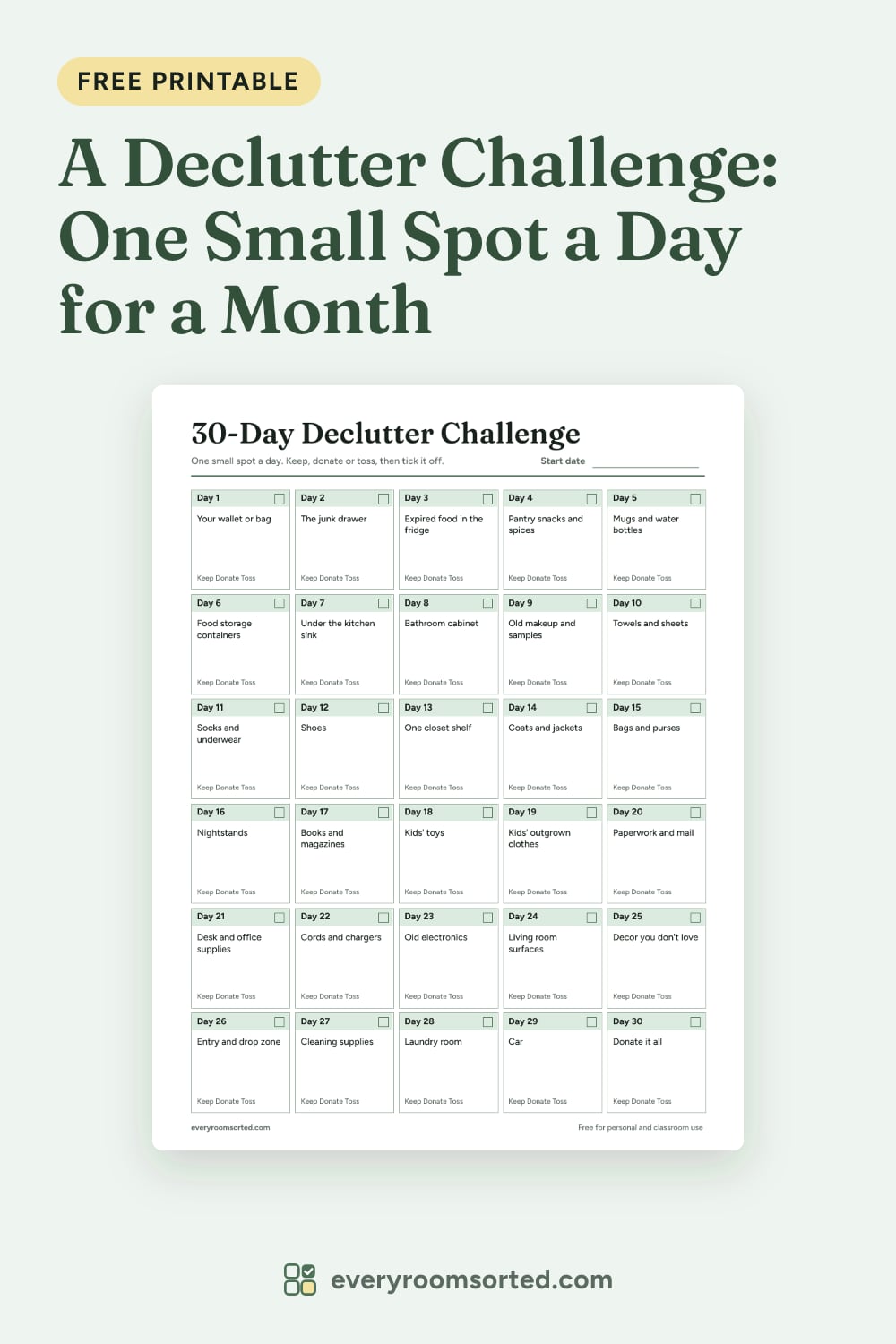
Save this for later
Pin it to a board so it's there when you're ready to start.
Save to Pinterest(opens in a new tab)Frequently asked questions
What is a 30-day declutter challenge?
It's a plan that gives you one small spot to clear each day for a month, instead of one big decluttering weekend. Each day takes a short session, and by the end every part of the house has had a pass.
What if I miss a day of the challenge?
Pick up at the next unticked square the following day. The squares don't have to match the calendar, so a missed day only moves your finish back. Don't clear two spots at once to catch up.
Can I do the days in a different order?
Yes. The order starts with the quickest spots to build momentum, but you can swap any days to fit your week. Save the car for a dry day, or move the toys to a day the kids are home to help.
Where should I keep the things I decide to donate?
Keep one box or bag by the door for the whole month and add each day's donations to it. The last square is for taking everything out of the house, so nothing drifts back onto a shelf.
More free printables
A room-by-room declutter checklist that tells you exactly what to look for, with four piles to sort into so nothing ends up back on the shelf.
Monthly Cleaning Schedule Printable
A one-page monthly cleaning schedule: the daily and weekly basics at the top, then one deeper area for each week, so every corner of the house gets its turn without a cleaning weekend.
Sunday Reset Checklist Printable
A one-page Sunday reset routine: clear the kitchen, the laundry and the living spaces, then get ready for Monday and plan the week, so the week starts calm instead of in a scramble.