Bin & Basket Size Calculator
Enter the width, depth and height of a shelf, a drawer or a cube cubby, and see which standard bins and baskets fit, how many, and how they line up.
Updated
Measure your space
In inches. Fractions work too, like 11 3/4. Nothing you type leaves your browser.
What fits
24 sizes fit a 30" × 16" × 12" shelf. Best fit: the narrow clear fridge and pantry bin, 7 of them.
Best fit
Narrow clear fridge and pantry bin
4" W × 14.5" D × 4" H
7 across × 1 deep = 7 containers
- 8" of room above it
- 0" left over side to side
Medium open-front pantry bin
13" W × 9.5" D × 5.25" H
3 across × 1 deep = 3 containers
- Turned sideways, so the long side runs front to back
- 6.75" of room above it
- 0.5" left over side to side
Tall woven-look basket
15" W × 12.25" D × 9.38" H
2 across × 1 deep = 2 containers
- Turned sideways, so the long side runs front to back
- 2.63" of room above it
- 4.75" left over side to side
Medium clear fridge and pantry bin
8" W × 14.5" D × 4" H
3 across × 1 deep = 3 containers
- 8" of room above it
- 5" left over side to side
6 x 9 drawer organizer tray
9" W × 6" D × 2" H
3 across × 2 deep = 6 containers
- 10" of room above it
- 2" left over side to side
3 x 9 drawer organizer tray
9" W × 3" D × 2" H
3 across × 4 deep = 12 containers
- 10" of room above it
- 2" left over side to side
How we calculate
- Each container gets 0.25" of room on every side, so 7 across need 7 × 4" + 8 × 0.25" = 30" of your 30" width.
- Front to back, 1 row needs 1 × 14.5" + 2 × 0.25" = 15" of your 16" depth.
- A shelf needs 1" above the container: 4" + 1" = 5", under your 12" height.
How to measure
Measure the inside of the space, not the outside of the furniture:
- Width: side to side at the narrowest point. On a shelf with a door, that’s usually the door opening or the hinges.
- Depth: from the front edge to the back wall. Stop at any trim, pipe or bracket in the way.
- Height: from the shelf to the underside of the shelf above. In a drawer, measure the inside of the drawer’s sides, not the drawer front.
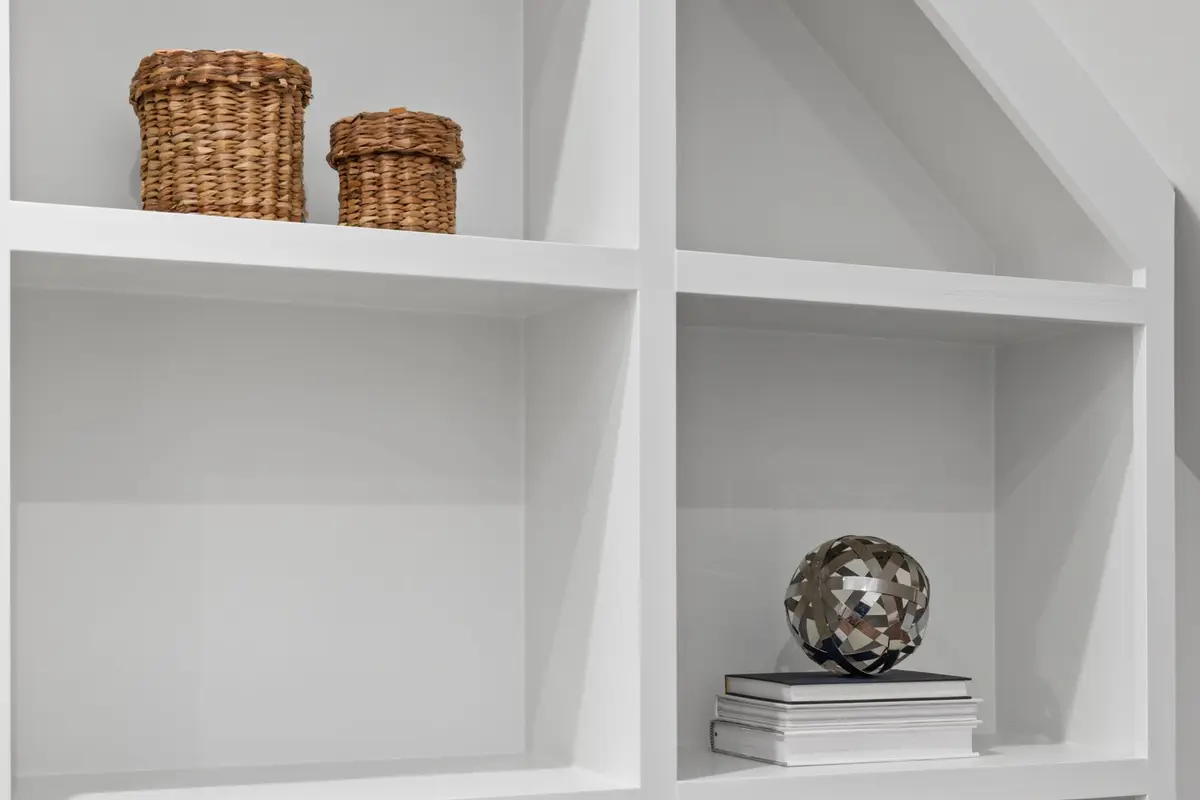
Round each measurement down to the nearest quarter inch. A bin that fits with nothing to spare is hard to pull out. Under a sink, measure each side of the drain pipe as its own space, as the under-sink organizing guide shows.
Type each measurement the way it reads on the tape: a decimal or a whole number with a fraction, with or without the inch mark.
Shelves with a door or a face frame
A frame around a cabinet opening is often narrower than the shelf behind it. A bin has to pass through the opening first, so enter the opening as the width.
Wire shelves
On a wire shelf, measure from the top of the wires to the underside of the shelf above. A shelf liner or a solid-bottom bin keeps small items from tipping between the wires.
Slanted ceilings and stair closets
Where the ceiling slopes, measure the height at the front of the shelf and again at the back. Enter the shorter number, or measure only the part of the shelf where a bin will actually sit.
Deep corner cabinets
In a blind corner cabinet, measure only the depth you can reach, and keep the back corner for things you rarely need.
Cube cubbies and drawers
Measure the cubby you’re filling rather than going by the size on the box. In a drawer, check the depth along the inside of the drawer box, since drawer slides and a thick front can make it shorter than the cabinet.
Reading the results
The result starts with how many sizes fit and the best fit. Each card below shows a container’s outside size, how many fit side by side and how many rows fit front to back, and the total.
The notes on each card tell you what to expect once the bins are in place:
- Room above it is the space between the top of the container and the shelf above, after the headroom the calculator keeps.
- Left over side to side is the gap that stays empty across the shelf. A wide gap can take a narrow bin.
- Turned sideways means the container fits more of them with its long side running front to back. The label then faces the side, so put it on the short end.
- Not a typical pick for this means the size fits your space, but it isn’t a container usually used for what you picked under “What are you storing.”
The top view draws the best fit inside your space, with the back of the space at the top.
Open “How we calculate” under the results to see the math with your own numbers: the width the bins take up, the depth of the rows and the height each one needs.
When nothing fits
If no size shows up, check the measurements first: a height taken from the cabinet floor instead of the shelf is an easy slip.
If the numbers are right, the space is smaller than every standard container on the list. A low shelf may work better with a shelf riser, and a narrow gap with items lined up and no bin at all.
A shelf keeps more headroom than a cubby or a drawer. If you will only slide the bins in and out, try the cubby setting under “What are you measuring?”
Worked examples
A pantry shelf
Shelf, 30" wide, 16" deep and 12" high, for pantry goods.
Narrow clear fridge and pantry bin (4" W × 14.5" D × 4" H): 7 across × 1 deep = 7 containers.
- Each container gets 0.25" of room on every side, so 7 across need 7 × 4" + 8 × 0.25" = 30" of your 30" width.
- Front to back, 1 row needs 1 × 14.5" + 2 × 0.25" = 15" of your 16" depth.
- A shelf needs 1" above the container: 4" + 1" = 5", under your 12" height.
24 standard sizes fit in all.
A desk drawer
Drawer, 15" wide, 18" deep and 3.5" high, for office.
3 x 6 drawer organizer tray (6" W × 3" D × 2" H): 2 across × 5 deep = 10 containers.
- Each container gets 0.25" of room on every side, so 2 across need 2 × 6" + 3 × 0.25" = 12.75" of your 15" width.
- Front to back, 5 rows need 5 × 3" + 6 × 0.25" = 16.5" of your 18" depth.
- A drawer needs 0.25" above the container: 2" + 0.25" = 2.25", under your 3.5" height.
8 standard sizes fit in all.
Common bin and basket sizes
These are the sizes the calculator checks, as outside measurements. They vary by a fraction of an inch between makers, so check the listing before you buy.
| Container | Width | Depth | Height |
|---|---|---|---|
| Plastic cube bin for 11-inch cubbies | 11" | 11" | 10" |
| Fabric cube bin for 13-inch cubbies | 13" | 15" | 13" |
| Half-height fabric cube bin | 11" | 11" | 5" |
| Narrow clear fridge and pantry bin | 4" | 14.5" | 4" |
| Medium clear fridge and pantry bin | 8" | 14.5" | 4" |
| Medium open-front pantry bin | 13" | 9.5" | 5.25" |
| Large open-front pantry bin | 14.25" | 11" | 7" |
| 6-quart shoe box | 13.5" | 8.13" | 4.63" |
| 16-quart lidded storage tote | 17.13" | 11.88" | 6.75" |
| 25-quart shelf tote | 19.88" | 15.5" | 7.75" |
| 32-quart latching storage tote | 24" | 16.5" | 6.5" |
| Small woven-look basket | 11.5" | 8.75" | 4" |
| Tall woven-look basket | 15" | 12.25" | 9.38" |
| Small wire basket | 9" | 8" | 5.25" |
| Medium wire basket | 14" | 11.5" | 8" |
| Large stacking basket | 17.13" | 12.88" | 7.25" |
| 3 x 3 drawer organizer tray | 3" | 3" | 2" |
| 3 x 6 drawer organizer tray | 6" | 3" | 2" |
| 3 x 9 drawer organizer tray | 9" | 3" | 2" |
| 6 x 6 drawer organizer tray | 6" | 6" | 2" |
| 6 x 9 drawer organizer tray | 9" | 6" | 2" |
| 9-inch turntable | 9.45" | 9.45" | 1.55" |
| 11-inch turntable | 11" | 11" | 1.68" |
| Magazine file holder | 3.94" | 10.44" | 12.06" |
| Letter-size desk paper tray | 13" | 9" | 2.75" |
| Stackable vanity basket | 12.5" | 8.63" | 5.38" |
| Open-front stacking toy bin | 14.75" | 10" | 8" |
| Large stackable toy bin | 20.88" | 16.5" | 13.13" |
Choosing bins by material
The size decides whether a bin fits. The material decides whether it suits what goes in it and the room it lives in.
- Clear plastic lets you see what’s inside and wipes clean, so it suits pantry goods, fridge and freezer bins, spare toiletries and craft supplies.
- Fabric is light and soft, so it suits cube cubbies, kids’ rooms and folded clothes. It doesn’t like spills or damp air.
- Woven baskets hide a mix of things and look calm on open shelves in a living room or bathroom.
- Wire lets air move and makes contents easy to spot, so it suits produce, cleaning supplies and the laundry room.
Thick walls and sloped sides take up room, so a bin holds less than its outside size suggests.
Room by room
Pantry and kitchen
Pick “Pantry goods” to see clear bins, open-front bins and turntables first. Narrow bins work well on deep shelves, where a whole row slides out at once. The small pantry organization ideas show how bins, turntables and baskets work together on a small shelf.
Closets
Pick “Clothes” and the calculator keeps extra headroom on shelves and in cubbies for lifting folded stacks. Lidded totes suit the high shelf for out-of-season clothes, and open bins suit the shelves you use every day.
Kids’ rooms and playrooms
Pick “Toys” to see cube bins and open toy bins first. Open bins at a child’s height are easier to tidy than lidded ones, and a picture label helps children who can’t read yet.
Bathroom and laundry
Pick “Bathroom” for vanity baskets, clear bins and turntables. Under a bathroom sink, measure around the pipes as you would in the kitchen, and pick bins that wipe clean in case of a drip.
Home office
Pick “Office” for file holders, paper trays and drawer trays; the count tells you how many trays of one size line the drawer.
Tips for choosing bins
- Declutter first. Measure for what you keep, not for everything you own now. The declutter checklist walks through it room by room.
- Pick one size per shelf. Matching bins line up, stack and look tidy, and you can move them around later.
- Use clear bins where you need to see the contents, like pantry goods and spare toiletries, and closed bins or baskets for everything that looks messy.
- Put lidded bins up high and open ones at hand height, where you reach in every day.
- Pull the back row forward. On a deep shelf, a bin you can slide out by its front edge keeps the back from turning into a place where things get lost.
- Buy one first, try it in the space, then buy the rest.
- Check the listing’s measurements. Some listings give inside sizes; the calculator uses outside sizes, so look for the outside dimensions.
- Label the front, so whoever puts things away knows where they go.
How we calculate
The calculator checks every standard size against your space:
- It leaves 0.25" of room on each side of every container and between containers, so they slide in and out.
- It leaves room above the container: 1" on a shelf, 0.5" in a cube cubby and 0.25" in a drawer. Folded clothes on a shelf or in a cubby get an extra inch, since you lift them out by the stack.
- It counts how many fit side by side and how many rows fit front to back, both the way the container is sold and turned sideways, and keeps the way that fits more.
- It lists the containers made for what you’re storing first, then the ones that cover the most of your shelf, so the least space goes to waste.
Save this for later
Pin it to a board so it's there when you're ready to start.
Save to Pinterest(opens in a new tab)Frequently asked questions
How do I know what size bins fit my shelves?
Measure the inside width, depth and height of the shelf, then subtract a little room on each side so the bins slide in and out, and leave room above to tip a bin out. The calculator above does that math for every standard bin size at once.
How much space should you leave around storage bins?
The calculator leaves a quarter inch on each side of every bin and between bins, and room above it: an inch on a shelf, half an inch in a cube cubby, and a quarter inch in a drawer, with an extra inch on shelves for folded clothes.
Should bins face front or sideways?
Front facing is easier to read and to pull out, so the calculator keeps that unless turning the bins fits more of them. When it turns them, the result says so.
Are the sizes inside or outside measurements?
Outside measurements, as the containers are sold. That's what has to fit your space. Sizes vary by a fraction of an inch between makers, so check the listing before you buy.