Declutter Checklist Printable
A room-by-room declutter checklist that tells you exactly what to look for, with four piles to sort into so nothing ends up back on the shelf.
Updated
Download the free PDF
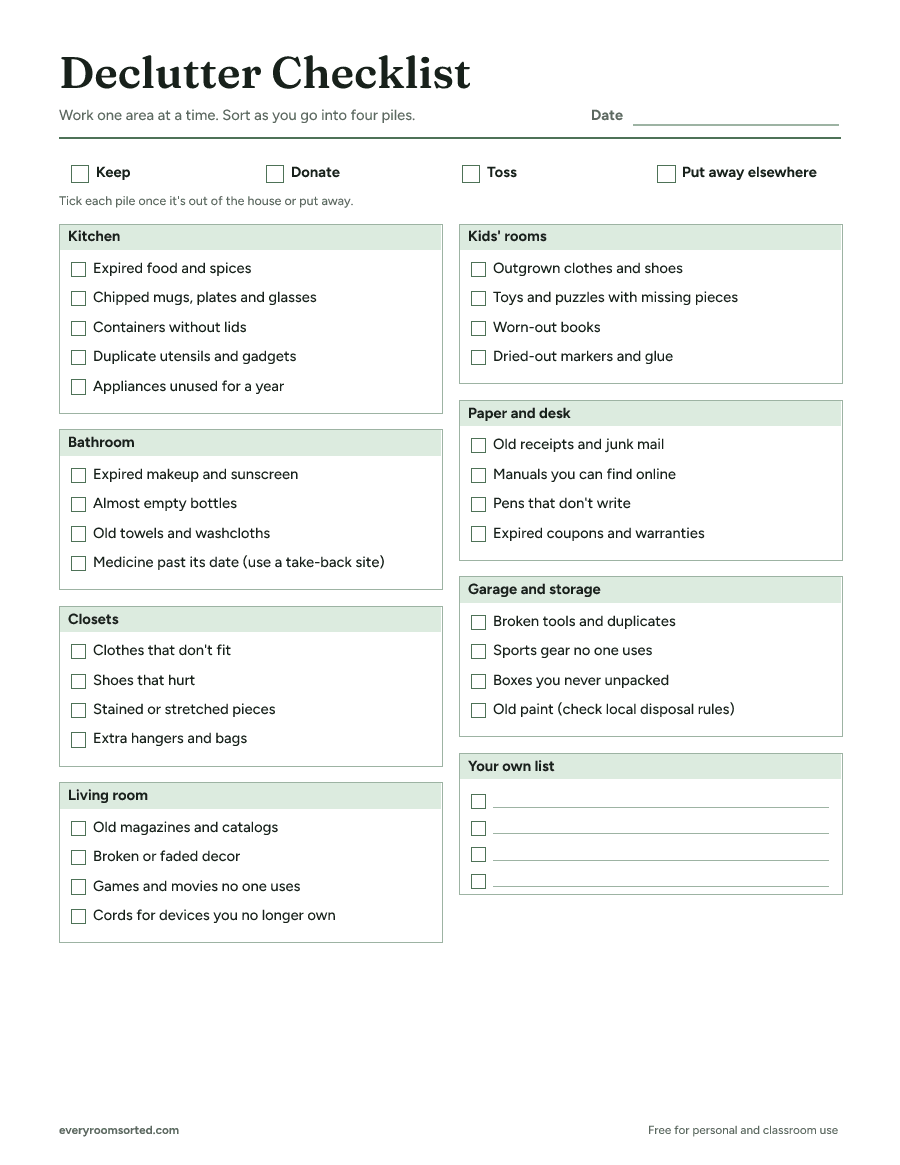
One US Letter page with light lines that are easy on ink. No sign-up, no email.
Download the PDFFree for personal and classroom use. Please share a link to this page rather than the file. Terms of use
Who it’s for
This checklist is for anyone who wants less stuff but doesn’t know where to begin. Instead of staring at a full closet, you get a short list of what to look for in each room, the things most homes hold on to without using.
It works just as well for a full-house purge as for one stubborn drawer. Print a copy for each round, so every room gets its own fresh page and its own date.
What’s on the page
- Four piles: keep, donate, toss, put away elsewhere, with a box to tick once each pile is dealt with.
- 7 areas: kitchen, bathroom, closets, living room, kids' rooms, paper and desk, garage and storage, each with what to look for.
- Your own list: blank lines for the spots only your home has.
How to use it
- Pick one area and set aside time to finish it.
- Set up the four piles with boxes or bags before you start.
- Go down the list and pull out everything that matches.
- Deal with the piles the same day: donations in the car, trash out, the rest put away where it belongs.
- Tick the area off and choose the next one.
Before you start
A little setup keeps a decluttering session from stalling halfway. Gather what you need first, so you never leave the room to hunt for a bag.
- Four containers, one for each pile. Laundry baskets, boxes or sturdy bags all work, as long as you can tell them apart.
- Trash bags and a recycling bag, since the toss pile fills fastest.
- A cloth and a spray cleaner for the empty shelves.
- A pen, to tick boxes and jot down anything you need to replace or return.
Pick a time when you won’t be pulled away, and decide in advance where the session ends. A clear finish line, like “the hall closet” or “the top two kitchen shelves,” keeps a short session from turning into a weekend.
How to sort each pile
The four piles keep every decision small. You’re not deciding what to do with the whole closet, only which box this one sweater goes into.
Keep
Keep what you use, what works and what you’d choose again. Keeping something isn’t a promise to keep it forever; it’s a decision for now.
Hold the keep pile to the space you have. If the keep pile won’t fit back on the shelf, go through it once more and let the weakest pieces move to another pile.
Donate
Donate things that work and that someone else could use today: clean clothes, whole sets, toys with all their pieces, books in good shape. Check what your local donation center takes before you load the car, since many turn away some kinds of items.
Anything stained, broken or missing parts isn’t a donation. It belongs in the toss pile, or in recycling where your town takes it.
Toss
Toss means out of the house, not just into a bag in the garage. Sort it into trash and recycling as you go, so it’s ready for pickup day.
Some things need special handling. Old paint, cleaners and other household chemicals often have their own drop-off days or sites, and used batteries, especially rechargeable ones, shouldn’t go in the household trash. Unused medicine goes to a take-back site rather than the bin.
Put away elsewhere
This pile is for things that are worth keeping but live somewhere else: the mug in the bedroom, the charger in the kitchen drawer. Don’t walk each item to its room while you sort; carry the whole pile around once at the end.
If something in this pile has no home anywhere in the house, that’s a sign. Either make a spot for it or move it to donate or toss.
When you can’t decide
Every room has a few things that stop you cold. Set them in a “maybe” bag instead of letting them stall the whole session, and come back to them once the easy piles are done.
A few questions help with the hard ones:
- Have you used it since the last time you came across it? If you forgot you owned it, you probably won’t miss it.
- Would you buy it again today? If not, the only reason to keep it is that you already have it.
- Is it standing in for something? One good pan does the job of three warped ones.
- Do you have room for it? A home holds only as much as its shelves, drawers and closets hold.
If a maybe still feels hard after that, date the bag and tuck it away. When the date comes around and you haven’t opened it, donate it without looking inside.
Sentimental things
Cards, baby clothes, kids’ artwork and things that belonged to family are the hardest to sort, so save them for last. By then, quicker decisions in other rooms will have made the slower ones easier.
Keep the best of a group rather than the whole group. One favorite drawing can stand for a year of them, and a photo of a bulky keepsake takes up no room at all.
Give sentimental keepers one container with a lid and a label. When the container is full, choose what comes out before anything new goes in.
Decluttering with kids or a partner
Shared rooms go better when everyone agrees on the plan first. Decide together which area you’re doing and what the piles mean, so nobody finds their things in a donation bag.
- Let kids sort their own things with simple choices, like “keep” or “give to another kid.” They’re more likely to keep a room tidy when they chose what stayed.
- Don’t sort someone else’s things without them. Set anything you’re unsure about on their bed or desk to decide later.
- Split the jobs. One person sorts and the other runs the piles, so the work keeps moving.
Keeping it from coming back
Decluttering lasts when fewer things come in than go out. A one-in, one-out habit works well for clothes, toys, mugs and anything else that tends to multiply.
Walk through each finished area again in a few months. It will take a fraction of the first round, and the checklist shows you where to look.
Tips for decluttering that lasts
- Don’t buy bins first. Declutter, then measure what’s left. The bin and basket size calculator shows which containers fit your shelves.
- Make lists of what needs doing. Errands like a donation drop-off fit on the to-do list.
- Clean as you clear. Once a shelf is empty, wipe it down, or save the bigger jobs for the deep cleaning checklist.
- Start small in the kitchen. A single cabinet, like the one under the sink, is a good first win, and the under-sink organizing guide walks through it step by step.
- Keep a donation bag in a closet and add to it whenever something stops earning its spot.
Save this for later
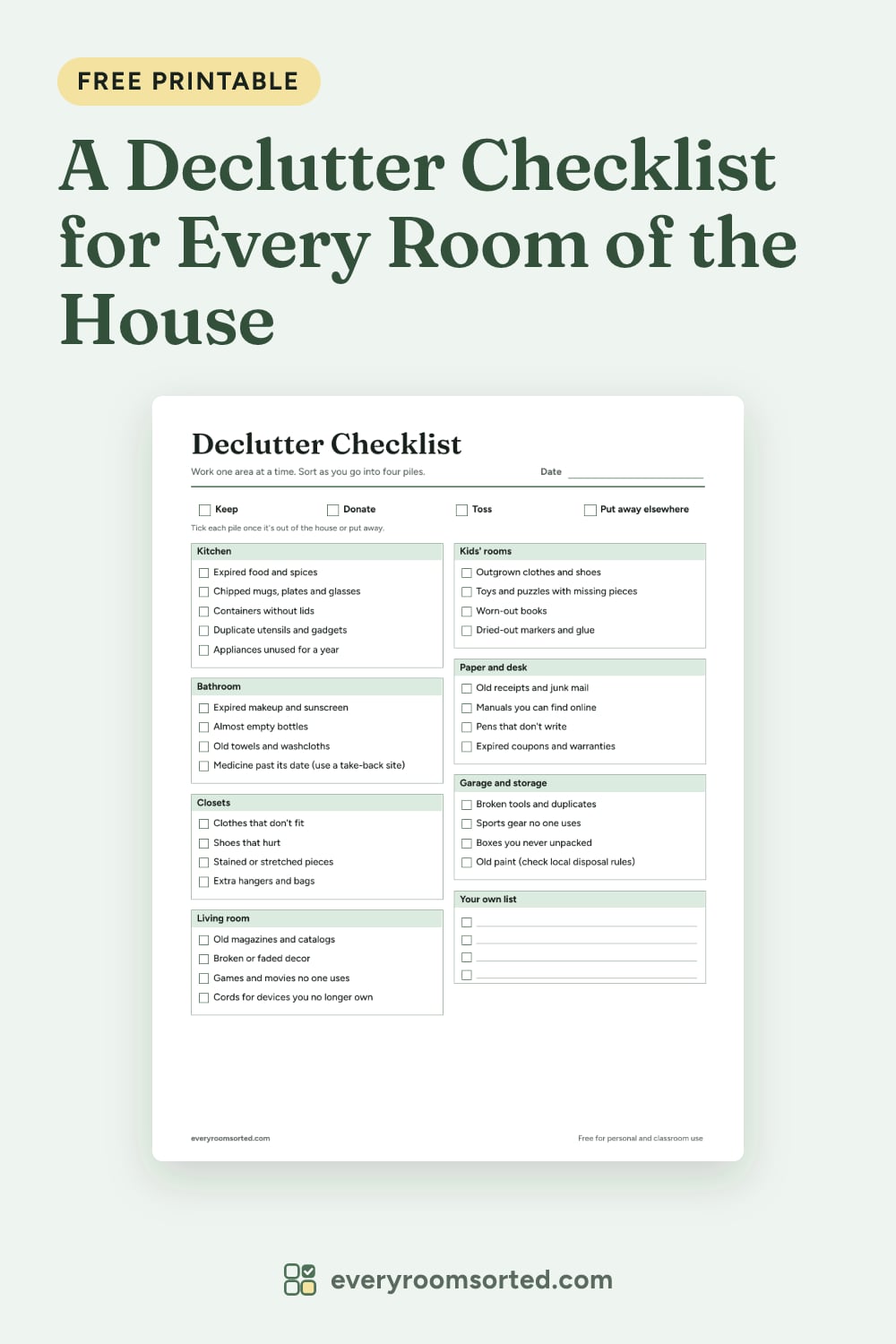
Pin it to a board so it's there when you're ready to start.
Save to Pinterest(opens in a new tab)Frequently asked questions
Where should I start decluttering?
Start with the room that bothers you most, or with a small space you can finish in one go, like a bathroom drawer or the coat closet. A finished space shows the difference and makes the next one easier.
How do I decide what to get rid of?
Ask whether you've used it in the last year, whether it works, and whether you'd buy it again today. If the answer to all three is no, it can go. Be quick with the easy items and set the hard ones aside for later.
What should I do with the things I don't keep?
Bag donations as you go and put them in the car the same day. Recycle what you can, toss what's broken, and check your town's rules for paint, batteries and electronics. Take unused medicine to a take-back site rather than the trash.
How long does it take to declutter a whole house?
It depends on the house and how much is in it, so don't aim for one weekend. One area a day, or one room a week, gets the whole house done without burning out.
More free printables
Weekly Cleaning Schedule Printable
A one-page weekly cleaning schedule: a few quick jobs every day, plus one focus area a day, so the whole house gets done without a cleaning marathon.
A room-by-room deep cleaning checklist for the jobs a weekly clean skips, from the oven and the grout to the vents and baseboards.
A one-page to-do list with today's top three at the top, plenty of lines to tick off underneath and a little room for notes.