Monthly Cleaning Schedule Printable
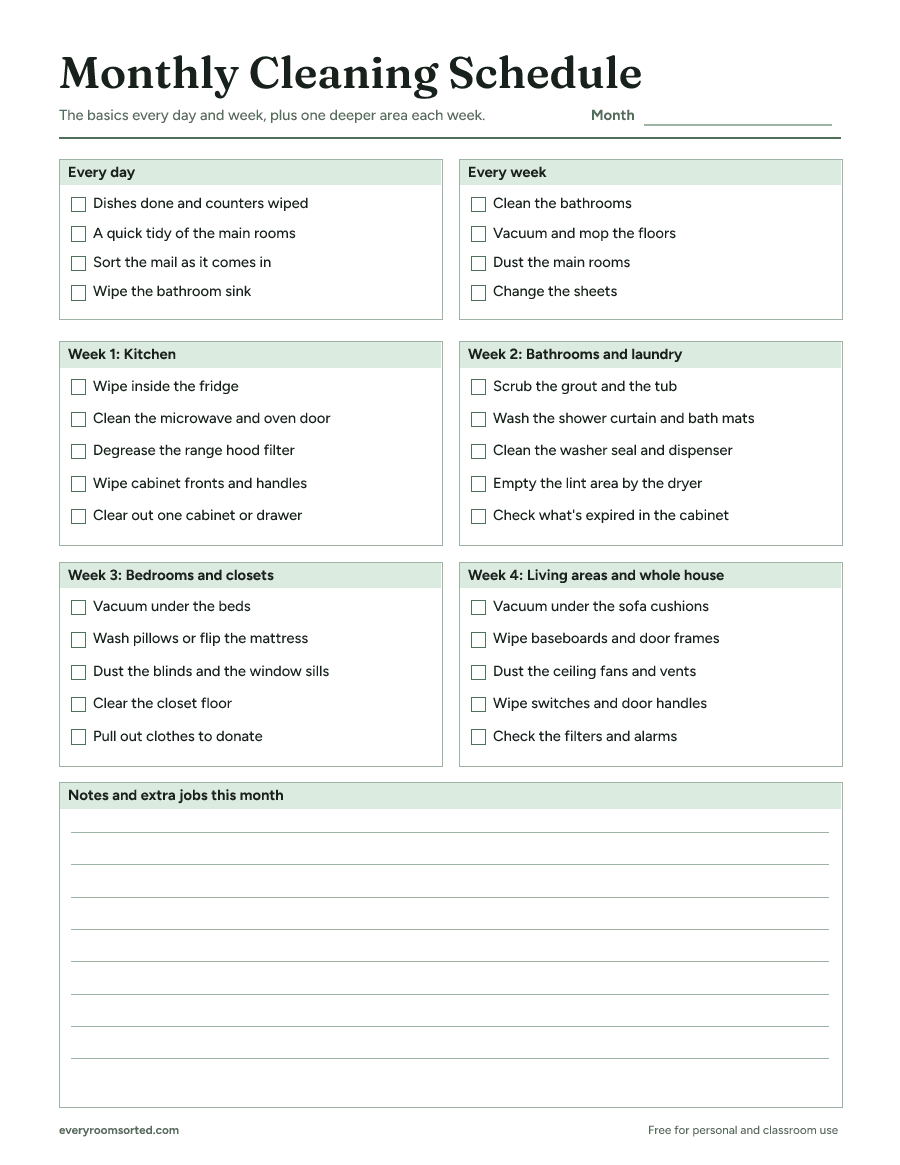
A one-page monthly cleaning schedule: the daily and weekly basics at the top, then one deeper area for each week, so every corner of the house gets its turn without a cleaning weekend.
Published
Download the free PDF
One US Letter page with light lines that are easy on ink. No sign-up, no email.
Download the PDFFree for personal and classroom use. Please share a link to this page rather than the file. Terms of use

Who it’s for
This monthly cleaning schedule is for homes that keep up with the dishes and the bathrooms but never quite get to the fridge shelves, the baseboards or the ceiling fans. It puts the daily and weekly basics at the top of one page, then gives each week of the month one deeper area, so every corner gets its turn without a cleaning weekend.
It sits between the other two cleaning sheets on the site. The weekly cleaning schedule plans the week day by day, and the deep cleaning checklist covers a one-time, top-to-bottom clean. This page spreads the in-between jobs over the month, so the next deep clean has less to catch up on.
What’s on the page
- Every day: 4 quick jobs with a box to tick, starting with “Dishes done and counters wiped.”
- Every week: 4 bigger jobs, like “Clean the bathrooms” and “Vacuum and mop the floors.”
- One area a week: 4 weeks with 5 deeper jobs each (20 in all), from the kitchen in the first week to the living areas and whole house in the last.
- Month and notes: a line for the month at the top and a box at the bottom for notes and extra jobs.
How to use it
- Print a fresh copy each month and write the month at the top.
- Put it where you’ll see it, like the fridge or the inside of a pantry door.
- Keep the daily and weekly jobs going the way you already do, and tick them as a reminder, not a test.
- Pick one slot each week for that week’s area, such as a weekday evening or a weekend morning, and work through its list.
- Write anything you skip or spot in the notes box, and carry it over to next month’s sheet.
Why a monthly plan works
Some jobs don’t need doing every week, but they build up quietly when nobody owns them. Grease on the range hood filter, dust on the fan blades, grime on the washer seal: each one is quick when it’s done monthly and a real chore when it waits for a season.
Giving each week one area keeps the extra work small. You add one short session to an ordinary week instead of finding a whole free day, and by the end of the month the whole house has had a deeper pass.
The basics: every day and every week
The daily jobs are the short resets that stop mess from piling up: dishes, counters, a quick tidy, the mail and the bathroom sink. Each one takes a few minutes, and together they make the house look cared for even on a busy day.
The weekly jobs are the ones most homes already know: bathrooms, floors, dust and fresh sheets. If you’d rather give each of them its own day, run the weekly schedule alongside this sheet and treat the boxes here as a check that they happened.
What each week covers
Each week’s area has its own short list. Do it in one session or split it over a few evenings; either way, finish the week’s area before the next one starts.
First week: Kitchen
Start with the fridge, since clearing it out shows what you have before the next grocery run. Take out one shelf at a time, wipe it, and put back only what you’ll use.
Soak the range hood filter in hot, soapy water while you clean the microwave, the oven door and the cabinet fronts. Finish by clearing out one cabinet or drawer, a different one each month, so the whole kitchen gets sorted over the year.
Second week: Bathrooms and laundry
Spray the grout and the tub first and let the cleaner sit while the shower curtain and bath mats go in the wash, as their care labels allow. Then come back to scrub and rinse.
In the laundry area, wipe the washer’s door seal, rinse the detergent dispenser and clear the lint from around the dryer. Before you leave the bathroom, check the cabinet for expired medicines and products, and dispose of them the way their labels direct.
Third week: Bedrooms and closets
Vacuum under the beds, then wash the pillows if their labels allow it, or flip or rotate the mattress if it’s made for that. Dust the blinds and the window sills from the top down.
The closet jobs are small decluttering sessions. Clear the closet floor and pull anything nobody wears into a bag to donate. When a closet needs more than a monthly pass, the declutter checklist goes through it in more detail.
Fourth week: Living areas and whole house
Lift the sofa cushions and vacuum underneath, then work through the house in one pass: baseboards and door frames, ceiling fans and vents, light switches and door handles.
End with the checks. Look at the furnace or air filter and change it when your system’s instructions say it’s due. Press the test button on each smoke alarm, since a monthly test is the habit to keep, and follow each alarm’s own instructions for batteries and replacement.
Fitting it to your home
The weeks are a starting order, not a rule. Swap any two if a different order suits your month.
A small apartment
With one bathroom and a small kitchen, a week’s list may take a single short session. Pair two weeks together if you like, and leave the other weeks free for catching up.
A big family
More people means a fuller fridge, more lint and more closet overflow. Split each week’s list between adults and older kids, and initial the boxes so everyone can see what’s done.
Kids and pets
Children can take the easy monthly jobs, like wiping switches and door handles or pulling outgrown clothes from the closet. With pets, vacuum under the cushions and the beds more often, and wash pet bedding with the bath mats in the second week.
Odd schedules
If your days off move around, ignore the calendar weeks and work through the areas in order whenever you have a free block.
When a month runs long
Most months run a few days past 4 full weeks. Use those spare days as a catch-up week: finish anything you skipped, or pick one job from the notes box.
When it stops working
If a week gets away from you, don’t try to do two areas the next week. Move the missed area to the catch-up days at the end of the month, or let it wait for next month’s sheet.
If the same job keeps getting skipped, it may not belong on a monthly list for your home. Move it to the seasonal deep clean, or write a smaller version of it in the notes box.
And if the daily jobs are slipping, pause the monthly areas for a week. The basics bring the house back first, and the deeper jobs can pick up again once they’re steady.
Work safely
Read each product’s label and use one cleaner at a time. Never mix bleach with other cleaners, since the mix can release fumes that are dangerous to breathe, and keep a window open while you work.
Use a sturdy step stool for fans and vents rather than a chair, and switch fans and lights off before you dust them.
Tips for sticking with it
- Put the week’s session on the calendar, the same evening each week, so it doesn’t depend on remembering.
- Keep a small caddy for the monthly jobs: a scrub brush, a grout brush, microfiber cloths and dish soap for the greasy parts.
- Keep last month’s sheet. Its notes show which jobs ran long and which ones you can fit into a shorter session.
- Plan the next week on Sunday. The Sunday reset checklist is a good moment to decide when the coming week’s area fits.
Save this for later
Pin it to a board so it's there when you're ready to start.
Save to Pinterest(opens in a new tab)Frequently asked questions
What should be on a monthly cleaning schedule?
The jobs that build up slowly but don't need doing every week: inside the fridge, the range hood filter, the grout, the washer seal, under the beds, the baseboards, the fans and the vents. Keep the daily and weekly basics on the same page so the monthly jobs stay extra, not a replacement.
How is a monthly schedule different from a deep clean?
A deep clean is a big, top-to-bottom round you do a few times a year. A monthly schedule spreads the in-between jobs over the weeks of the month, so the house never drifts far and the next deep clean has less to catch up on.
What if I miss a week?
Don't double up the next week. Most months have a few spare days at the end, so do the missed area then, or let it wait for next month's sheet.
Can I change which area goes in which week?
Yes. The order is a starting point, so swap any two weeks if another order suits your month. Cross out a week's heading and write your own if your home needs a different area altogether.
More free printables
Weekly Cleaning Schedule Printable
A one-page weekly cleaning schedule: a few quick jobs every day, plus one focus area a day, so the whole house gets done without a cleaning marathon.
A room-by-room deep cleaning checklist for the jobs a weekly clean skips, from the oven and the grout to the vents and baseboards.
Sunday Reset Checklist Printable
A one-page Sunday reset routine: clear the kitchen, the laundry and the living spaces, then get ready for Monday and plan the week, so the week starts calm instead of in a scramble.