Meal Planning Printable
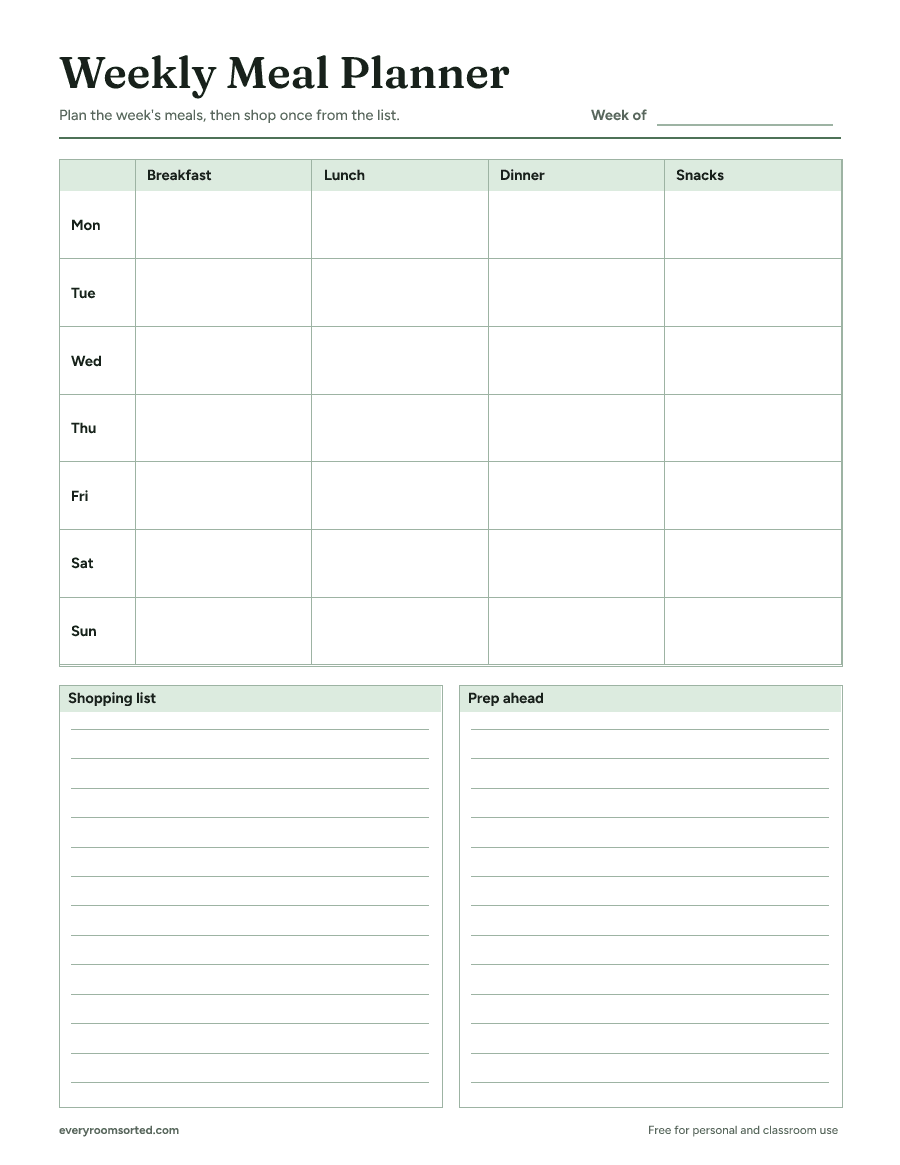
A free one-page meal planner with a row for each day, a column for each meal, and room for the shopping list and the prep. Plan the week once, then shop once.
Published
Download the free PDF
One US Letter page with light lines that are easy on ink. No sign-up, no email.
Download the PDFFree for personal and classroom use. Please share a link to this page rather than the file. Terms of use
Who it’s for
This meal planner is for busy households tired of deciding dinner at the last minute. You plan every meal of the week on one page, write what you need on the shopping list beside it, and shop once.
It works for one person cooking for themselves, a couple, or a family feeding kids with different schedules. The grid stays the same; only how much you write in each box changes.
What’s on the page
- A “Week of” line at the top, so every sheet has its date.
- The meal grid: a row for each day from Monday to Sunday and a column for each of the 4 meals: breakfast, lunch, dinner and snacks.
- A shopping list with lines for everything the plan needs that isn’t already in the house.
- A prep ahead box for the jobs you can do once to make the whole week faster.
How to use it
- Pick a planning day, the same one each week, and write the date on the “Week of” line.
- Check what you already have in the fridge, freezer and pantry, and plan meals that use it first.
- Fill in the dinner column first, then breakfast, lunch and snacks.
- Write the shopping list as you go, one ingredient a line, skipping what’s already on hand.
- Put the sheet on the fridge and do each prep job on the day you wrote beside it.
Why planning the week works
Deciding what to cook is often harder than cooking it. When the decision is already made, a weeknight dinner is just a matter of following the sheet.
One plan also means one shopping trip. Every ingredient goes on the list while you plan, so there are fewer midweek runs to the store for the one thing you forgot.
And the food you buy gets used. When you plan around what’s already in the fridge, produce gets eaten before it wilts, and leftovers get a night of their own instead of a spot at the back of the shelf.
What each part covers
The meal grid
Each box is small on purpose: write the meal, not the recipe. “Tacos,” “pasta bake” or “leftover soup” is enough. If a meal needs a recipe, note where to find it.
Write in pencil if your week often changes. A meal that moves to another day is then a quick erase instead of a crossed-out box.
Leave a box blank when you’ll eat out or someone else is cooking. A blank box you chose is still part of the plan.
Breakfast and Lunch
These meals rarely need much thought. A short rotation keeps them simple: write each one once and draw an arrow across the days it repeats.
Packed lunches belong here too. Plan the next day’s lunch around tonight’s dinner, and you cook once for two meals.
Dinner
Dinner is where the plan pays off. Mix a quick meal or two for busy nights with something slower for a night you’re home early, and give leftovers a night of their own.
Look at the week’s calendar before you fill this column. Practice, late meetings and a night with guests all change what’s realistic, and the weekly planner shows the whole week at a glance.
Snacks
Writing snacks down keeps them from turning into a daily raid on the pantry. Plan a few for the week, buy those, and keep them on a shelf kids can reach.
Shopping list
Write each ingredient as you plan the meal that needs it, so nothing slips through. Before you leave, check the list against the pantry and cross out anything that turns up.
For a big weekly shop, copy it onto the grocery list, which sorts items by store section so you walk the store in one loop.
Prep ahead
This box is for jobs that make several meals faster: washing and chopping vegetables, cooking a pot of rice, making a sauce, or browning meat for two dinners at once. Write the day you’ll do each one.
Add a note to move frozen food to the fridge to thaw the night before you need it. Forgetting that one step is an easy way to lose a planned dinner.
Planning a month of meals
The sheet holds one week, the easiest span to plan well. To plan a month, print one sheet for each week and write each week’s date on its “Week of” line.
You can fill them all in at once, or plan the first week in full and sketch only the dinners for the rest. The details fill in as the month goes and your schedule settles.
Keep the month’s sheets together, in a folder or clipped to the fridge. At the end of the month, the weeks that worked become a ready-made plan you can use again.
Fitting it to your home
The grid is a starting point. Use the parts that help and leave the rest blank.
A small apartment
With a small fridge and little storage, plan meals that share ingredients. One bunch of herbs or a bag of spinach can turn up in several meals, so nothing goes to waste and the fridge stays clear.
A big family
Plan leftovers on purpose: cook a double batch and turn it into the next day’s lunches. Ask everyone for one dinner they want that week, so the plan has something for each person.
Kids and picky eaters
Let kids pick a dinner or help choose the week’s snacks. Pair a new dish with a side they already like, so there’s always something on the plate they’ll eat.
Older kids can take one night to help cook. Write their name in that box, and the plan doubles as a reminder.
Shift work and odd hours
The grid doesn’t care what time you eat. If your first meal of the day happens in the afternoon, use the columns for the meals you actually eat, and start the week on your first day off.
Cooking for one
Plan a few meals that make two or three servings, and write the extra servings into the boxes for the next days. You cook less often and still eat something different from day to day.
When the plan stops working
Every plan meets a week that falls apart. Swap meals between days instead of skipping them, and keep one easy pantry dinner as a backup for the night nothing goes right.
If you keep skipping the same column, the plan is asking too much. Plan dinners only for a while, and add the other meals back once that’s a habit.
If planning itself starts to feel like a chore, look at your old sheets. A month of past plans is a list of meals your household already likes, ready to copy into next week.
Tips for easier meal planning
- Use a theme night or two, like soup night or pasta night, so some boxes almost fill themselves.
- See what you have before you plan. A tidy shelf shows it at a glance, and the small pantry ideas help even a tight cupboard work that way.
- Plan on the same day each week, before you shop, so it becomes routine.
- Keep a list of favorites on the back of the sheet, and pick from it when you’re stuck.
- Share the job. Anyone in the house can add a meal to the grid or an item to the list.
Save this for later
Pin it to a board so it's there when you're ready to start.
Save to Pinterest(opens in a new tab)Frequently asked questions
How do I start meal planning?
Start with dinners only, since they take the most thought. Check what's already in the fridge and pantry, plan meals that use it up, then write down what's missing. Add the other meals once dinners feel easy.
Can I use this as a monthly meal planner?
Yes. Print one sheet for each week of the month and fill them in on the same day, or plan one week at a time as the month goes. Planning week by week leaves room for a schedule that changes.
What goes in the Prep ahead box?
Anything you can do once to make the week's meals faster: washing and chopping vegetables, cooking a pot of rice, making a sauce, or moving something from the freezer to the fridge to thaw. Write the day you'll do it beside each job.
What if I don't follow the plan every night?
That's normal. Swap meals between days as the week changes, and keep one easy pantry dinner for the night that falls apart. A plan you adjust still beats deciding from scratch at the last minute.
More free printables
A simple one-page weekly planner with the week's top three priorities, a box for each day and room for notes.
A one-page grocery list sorted by store section, with a box to tick for every item, so you write the list once and shop the store in one loop.
Free printable spice jar labels to cut out and stick on. Print the ready sheet of common spices, or type your own list and download labels made for your shelf.