Weekly Planner Printable
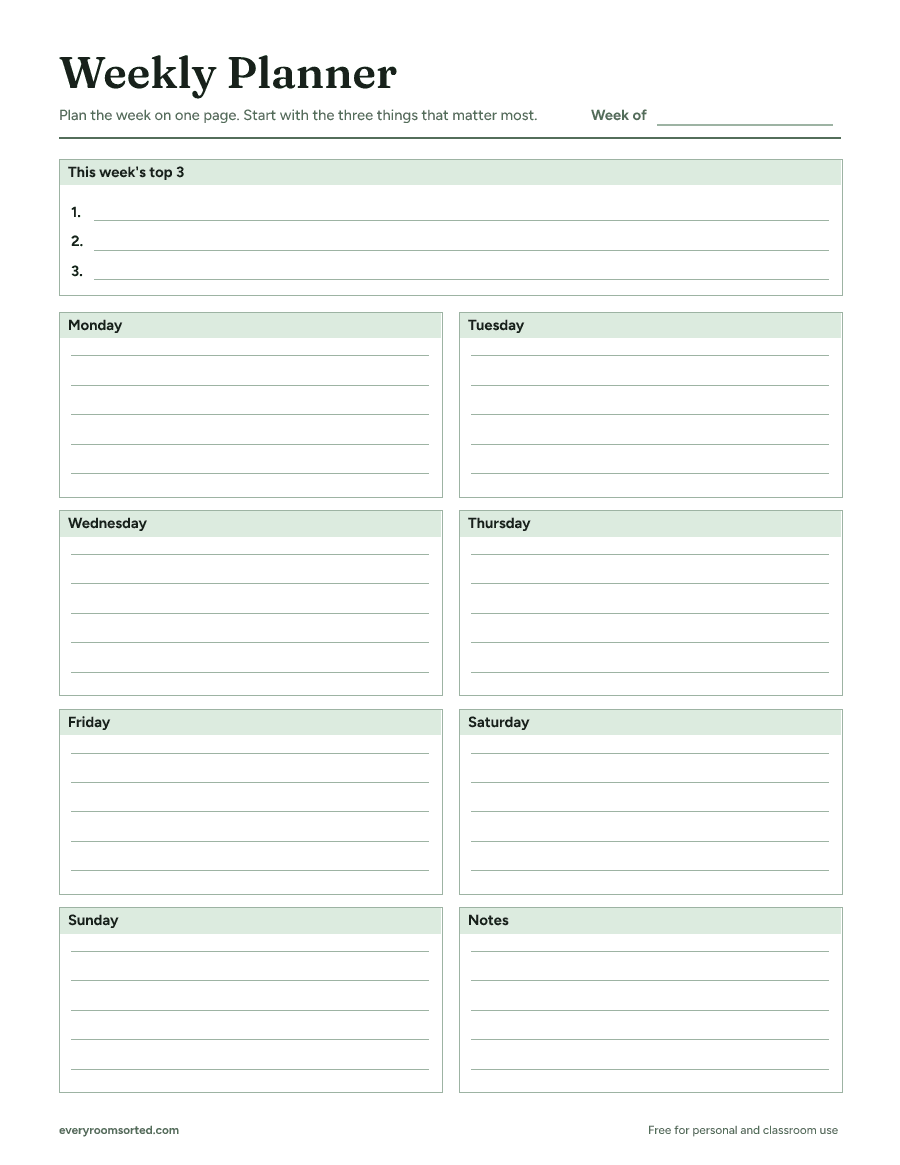
A simple one-page weekly planner with the week's top three priorities, a box for each day and room for notes.
Updated
Download the free PDF
One US Letter page with light lines that are easy on ink. No sign-up, no email.
Download the PDFFree for personal and classroom use. Please share a link to this page rather than the file. Terms of use

Who it’s for
This planner is for anyone who wants to see the whole week at a glance without a thick planner book. It works for family schedules, work weeks, school weeks and anything in between, and it’s plain enough to use for all of them.
It suits a household where several people’s plans have to fit around each other. One page on the fridge shows who needs a ride, which night is busy and when there’s time to breathe, without anyone opening an app.
What’s on the page
- This week’s top 3: the three things that matter most, written where you’ll see them first.
- A box for each day, Monday to Sunday, with lines for appointments, tasks and reminders.
- Notes: a spot for grocery items, ideas or what’s coming up next week.
The “Week of” line at the top right holds the date the week starts, so a stack of old pages stays in order if you keep them.
How to use it
- Fill in the date and print a fresh page each week.
- Add the fixed things first: appointments, school events, bill due dates.
- Choose your top three and give each one a day to happen.
- Keep it where you’ll look, on the fridge, on your desk or folded in your bag.
- Review it at the end of the week and move anything unfinished to the next page.
A weekly planning routine
The page works best when filling it in becomes a small habit at the same time each week. Pick a day you can count on, set the page and a pen out, and give it a short, unhurried sitting.
Look back first
Before you write anything new, read last week’s page. Circle what didn’t get done and ask whether it still matters.
Anything that does matter goes on the new page. Anything that doesn’t gets crossed off for good, which is its own small win.
Gather what’s coming
Check the places plans hide: school notes, the family calendar, work email, appointment cards on the counter and any messages about practices or games. Write every fixed time into its day before you plan anything flexible.
Fixed things are the frame of the week. Once they’re down, you can see which days are full and which have room.
Pick the top three
Now choose the three things that would make this week a good one. They can be big or small: finishing a work report, booking a checkup, clearing out the coat closet.
Write each one in the top box, then give it a day. A priority with a day attached is a plan; one without a day tends to drift to next week.
Fill in the rest
Add the smaller tasks, errands and reminders to the days that have room for them. Leave the heaviest days light on purpose.
How to fill in each part
The top three box
Write each priority as something you can finish, not a vague goal. “Book the dentist” fits on one line and has a clear end; “sort out health stuff” doesn’t.
If a priority is too big for one week, write the part you can finish this week. The rest waits for next week’s page.
The day boxes
Start each box with times, written at the left edge, so they’re easy to spot: a pickup, a meeting, a delivery window. Use the lines below for tasks that can happen any time that day.
A simple mark helps you read the page fast. Try a small box for tasks, a dot for appointments and a star for the day’s priority from the top box.
The notes box
Use it for anything that doesn’t belong to one day: the grocery items you think of during the week, gift ideas, a question for the teacher, next week’s early start.
When you plan the following week, read the notes box first. It’s usually full of things that belong on the new page.
Planning around a busy family
When kids have activities, sports, lessons and school events, write each person’s plans with their initial in front. Anyone glancing at the page can see whose day it is.
Plan meals right on the page too. A word or two on each day, like “tacos” or “leftovers,” takes the dinner question off every afternoon and makes the grocery list easier to write.
On nights with a late practice or meeting, plan something quick or something made ahead. Writing it down early is what makes the busy night work.
Ask everyone old enough to write to add their own plans during the week. A permission slip, a game moved to Saturday or a friend’s birthday party goes on the page the day it comes up, not the night before.
When the week doesn’t go to plan
Some weeks fall apart: a sick child, a car repair, a deadline that moves. That’s what the page is for, not a sign it failed.
Cross out what can’t happen, draw an arrow to a new day for what still must, and let the rest wait. A planner that bends is one you’ll keep using.
If the same task keeps moving from day to day, it’s usually too big or too vague. Break it into a first step small enough to do in a few minutes and write only that step.
Tips for planning that works
- Plan cleaning right in. The weekly cleaning schedule gives each day a focus area, so you can write it straight onto the planner.
- Keep a daily list. For days with a lot going on, a to-do list holds the details so the planner stays readable.
- Leave white space. A day packed from top to bottom has no room for the unexpected.
- Plan the kids’ jobs too with the kids chore chart.
- Give big projects a day. A weekend spent clearing out a room goes better with the declutter checklist and one line on the planner that says when.
- Use one planner. Two calendars, a phone and a stack of sticky notes is how things get missed. Put everything on the one page.
Printing and keeping your pages
The planner prints on one US Letter page in black and white or color. Light lines keep it easy on ink, so printing a fresh page every week costs very little.
Print a few weeks at a time and keep them in a folder near where you plan, so a blank page is always ready. A clipboard on a hook or a magnet on the fridge keeps the current week in view.
Keep old pages for a while if you like looking back. They’re a quick way to remember when something happened, or to spot which weeks always run full.
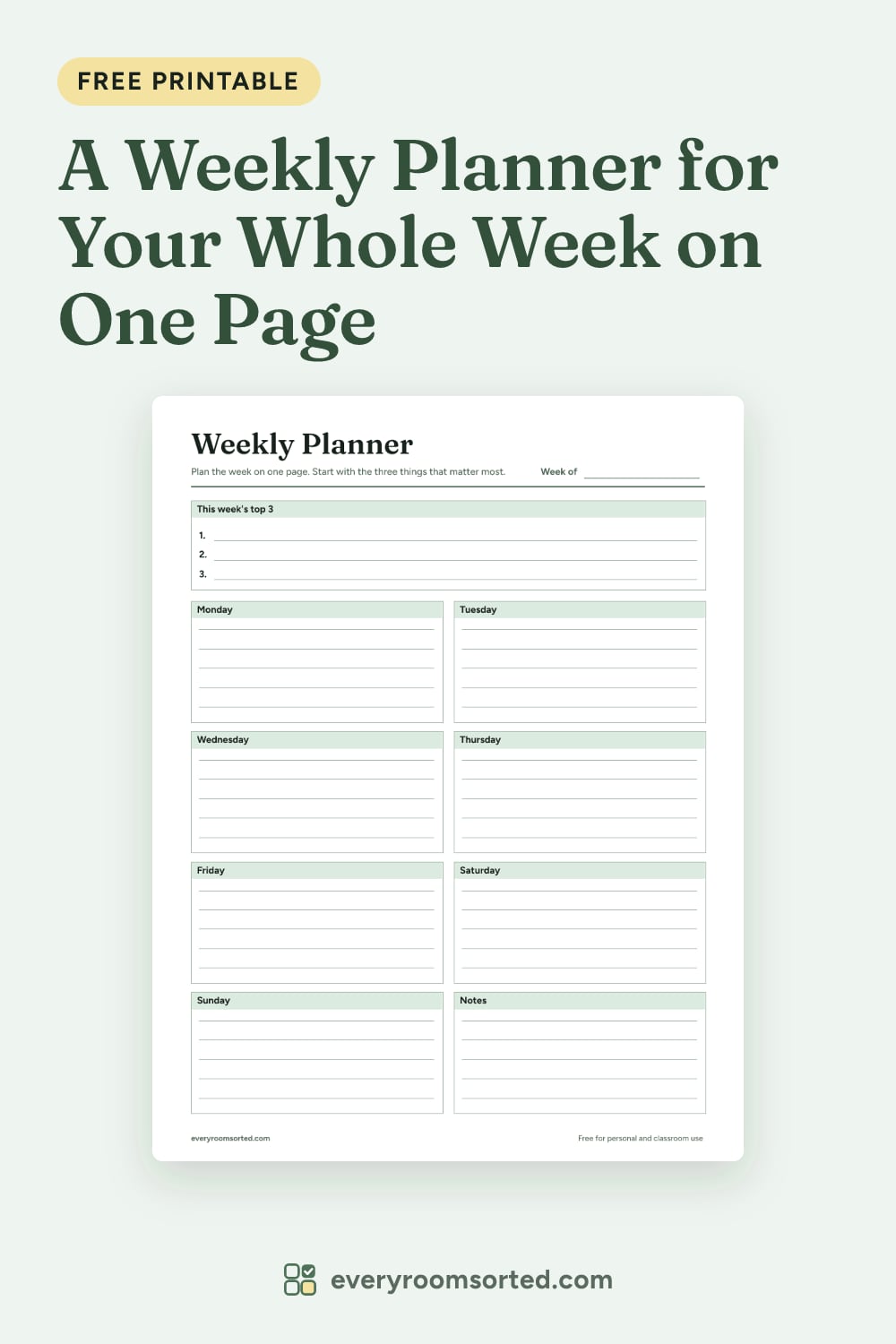
Save this for later
Pin it to a board so it's there when you're ready to start.
Save to Pinterest(opens in a new tab)Frequently asked questions
How do I use a weekly planner?
Sit down once at the start of the week, write in the fixed things first (appointments, school events, work deadlines), then choose your top three priorities and give each one a day. Check the page each morning.
What's the best day to plan the week?
Whichever day you can count on having a few quiet minutes. Sunday evening gives you a fresh start for Monday, and Friday afternoon works too, while the week that's ending is still fresh in your mind.
Can I print it double-sided or in color?
It's one page, so there's nothing on the back. It prints well in black and white or color on any home printer, on standard US Letter paper.
Is this planner free for teachers to use?
Yes. It's free for personal and classroom use. Print as many copies as your class needs; please share a link to this page instead of sharing the file.
More free printables
Weekly Cleaning Schedule Printable
A one-page weekly cleaning schedule: a few quick jobs every day, plus one focus area a day, so the whole house gets done without a cleaning marathon.
A one-page to-do list with today's top three at the top, plenty of lines to tick off underneath and a little room for notes.
A free kids chore chart with a box to tick for every day of the week. Print it as it is, or add your child's name and their own chores first.