Spice Jar Labels
Free printable spice jar labels to cut out and stick on. Print the ready sheet of common spices, or type your own list and download labels made for your shelf.
Published
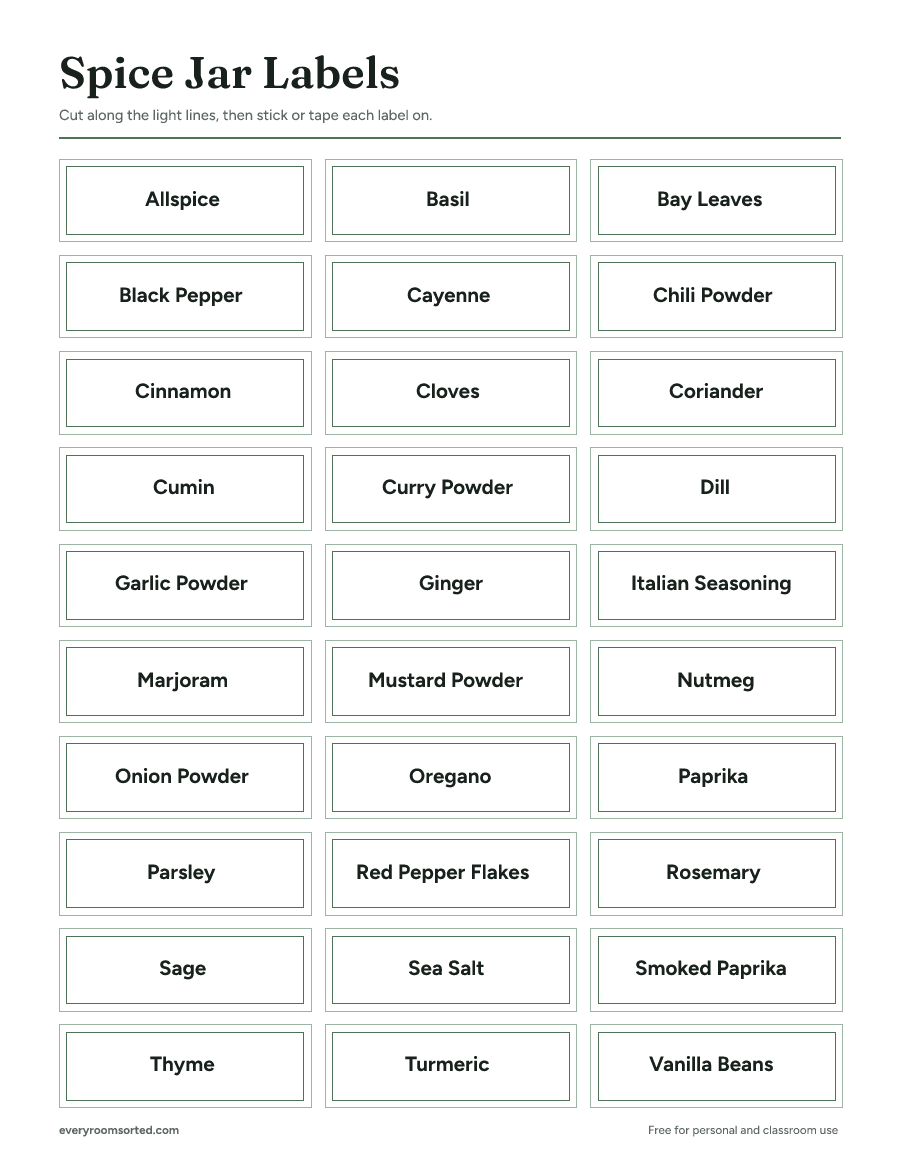
Download the free PDF
One US Letter page with light lines that are easy on ink. No sign-up, no email.
Download the PDFFree for personal and classroom use. Please share a link to this page rather than the file. Terms of use
Make it your own
Type the spices you actually have, one a line, then download labels made for your shelf. What you type stays in this page and is never sent anywhere.
Who it’s for
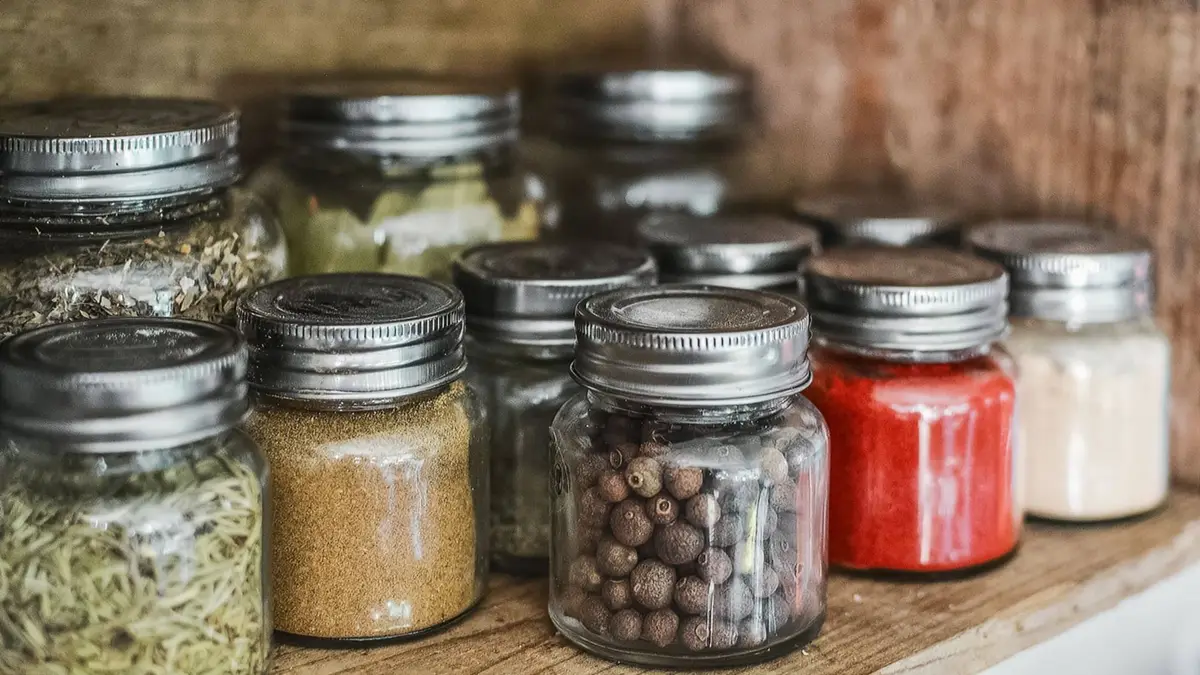
These labels are for anyone whose spice jars look alike from above, or whose spices live in a mix of jars, tins and bags. A clear name on every jar means you reach for the right one on the first try, even halfway through a recipe.
They suit a small drawer of basics as well as a full rack. Print the ready sheet as it is, or type your own list in the form above and get labels for exactly the spices you own.
What’s on the page
- 30 labels on one sheet, 3 across, each with a light cut line and a thin sage frame inside it.
- The ready sheet prints common spices in alphabetical order, from Allspice to Vanilla Beans.
- Your own sheet from the form above: up to 30 spices of up to 22 characters each, with every name sized to fit on one line.
- A line to write on on any label you leave empty, ready for spices you add later.
How to use it
- Take stock of your spices and set aside any whose smell has faded.
- Print the ready sheet, or type your own list in the form above and download your labels.
- Cut along the light lines, keeping the sage frame whole on each label.
- Stick each label on the lid or the front of its jar.
- Put the jars back in order, alphabetical or by cuisine, and keep that order every time.
Making labels for your own spices
The form above turns your list into a sheet of labels made for your shelf. Write each spice on its own line, in the order you want the labels on the page. Blank lines are skipped.
When you press “Download my labels,” the PDF is drawn right in your browser. Nothing you type is sent anywhere or saved, so keep the downloaded file if you want to print the same labels again.
A few things make the finished labels easier to use:
- Use the name you look for. Write the spice the way you’d say it out loud, so your eye finds it without a second read.
- Keep names short. A label holds up to 22 characters, and shorter names print larger.
- Leave room to grow. Type fewer than 30 spices, and the rest of the sheet prints with a line to write on, ready for the next jar you bring home.
- Add your blends. A homemade taco mix or a favorite rub deserves a label as much as a single spice.
- List them in shelf order, so you can stick the labels on in the same order you cut them out.
Printing and cutting
Print at actual size rather than “fit to page,” so the labels come out the size they were drawn.
Plain paper
Plain printer paper is the simplest choice. Cut out each label and fix it with a glue stick, or lay a strip of clear tape over it that runs past the edges on every side.
The tape does double duty: it holds the label on and keeps splashes and greasy fingers off the print, so the name stays clear.
Sticker paper
Full-sheet sticker paper turns every label into a sticker. Print a test page on plain paper first to check which way your printer feeds, then load the sticker sheet with the printing side the right way.
Cut out one label at a time, peel it, and press it on from the middle outward, so no air bubbles get trapped under it.
Cutting cleanly
Cut along the light outer lines, not the sage frame, so each label keeps its border. A paper trimmer, or a craft knife with a metal ruler, gives straight edges quickly, and scissors work fine too.
Sticking them on
Wipe each jar clean and dry before you add a label. Glue, tape and stickers all hold better on a surface without dust or oil.
Lids
Lid labels are for jars you look down on: in a drawer, a shallow basket or a deep shelf where only the tops show. If a label is wider than the lid, trim the ends and keep the name in the middle.
Fronts
Front labels suit jars standing on a shelf, a step riser or a door rack. Stick them at the same height on every jar, so the names line up across the row and are easy to scan.
On a round jar, set the label straight on the curve and smooth it outward from the middle to both sides, so the edges don’t lift.
Alphabetical or by cuisine
There’s no wrong order. What matters is that everyone in the house knows it and puts the jars back the same way.
Alphabetical
Alphabetical order works when you have a lot of jars or share the kitchen. Anyone can find anything without learning your system, and the ready sheet already prints in that order.
File blends under the word you’d look for first, like taco or curry, so they’re as easy to find as single spices.
By cuisine or use
Grouping by cuisine or use works when you cook a few styles often: the jars for a curry together, the baking spices together, the taco night spices together. One reach gets you everything a recipe needs.
You can mix the two: groups by cuisine, alphabetical inside each group. The small pantry ideas show more ways to fit jars into a tight space, from step risers to door racks.
Keeping labels readable
Kitchens are hard on paper. A few habits keep the names clear for longer.
- Keep jars away from the stove. Steam and grease wear labels down, and a rack above the stove is hard on the spices too. They keep their quality best in airtight jars, in a dry spot away from sunlight and heat.
- Wipe jars with a dry or barely damp cloth, not a wet one, so paper labels don’t wrinkle or peel.
- Reprint a label as soon as it smudges. Keep your downloaded PDF, so a fresh label is always one print away.
- Fill in blank labels with a fine permanent marker in dark ink, so handwritten names match the printed ones.
When your spices change
Spice collections grow. Use the blank labels for new jars, and when they run out, make a new sheet with just the new names.
Each time you refill or relabel, check what you have. Smell each spice, and replace any whose aroma has faded, since that’s the flavor you cook with.
When you finish a spice you rarely use, think twice before replacing it. A smaller collection is easier to keep labeled and in order.
Tips for a tidy spice shelf
- Declutter before you print. Combine duplicate jars and let go of spices you never reach for; the kitchen section of the declutter checklist covers them.
- Use matching jars if you’re starting fresh, so every label sits at the same height and the shelf looks calm.
- Keep the spices you use most in front, and the rest behind or on a higher step.
- Write the date you filled a jar on the back of its label, so you can tell how long it’s been open.
- Label the refill bags too, with a spare label or a marker, so backups are as easy to find as the jars.
Save this for later
Pin it to a board so it's there when you're ready to start.
Save to Pinterest(opens in a new tab)Frequently asked questions
What paper should I use for spice jar labels?
Plain printer paper works if you stick the labels on with clear tape or a glue stick. Full-sheet sticker paper saves a step, since you cut each label out and peel it off. Both run through a regular home printer.
Can I make labels for my own spices?
Yes. Type your spices into the form on this page, one a line, and download a sheet made for you. Any label you don't fill prints with a line to write on, for spices you buy later.
Is what I type into the form saved anywhere?
No. The labels are made in your browser, and nothing you type is sent to us or anyone else or kept after you leave the page. Save the downloaded PDF if you want to print the same labels again.
Should the labels go on the lid or the front of the jar?
Put them where you look first. Lids suit jars in a drawer or a basket you look down into, and fronts suit jars on a shelf, a riser or a door rack. Label both if your jars move between the two.
More free printables
30-Day Declutter Challenge Printable
A one-page declutter challenge for a month: one small spot to clear each day, easiest first, so the whole house gets a pass in short sessions.
A free one-page meal planner with a row for each day, a column for each meal, and room for the shopping list and the prep. Plan the week once, then shop once.
A one-page grocery list sorted by store section, with a box to tick for every item, so you write the list once and shop the store in one loop.