12 Kitchen Drawer Organization Ideas for Utensils, Knives and Wraps
Give every kitchen drawer one job: sort what's inside, measure for dividers, then make room for utensils, knives, spices, wraps and the junk drawer.

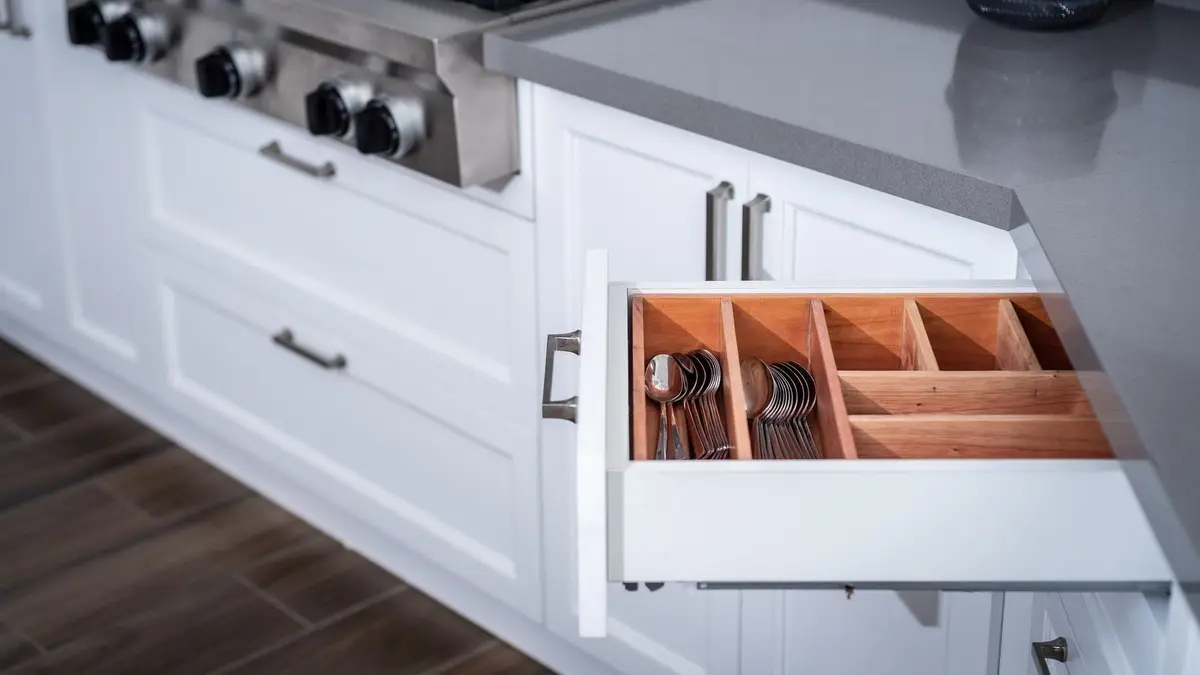
Kitchen drawers stay organized when each one has a single job. Clear out what you don’t use, measure the inside of each drawer, then add dividers so flatware, cooking tools, knives, spices, wraps and odds and ends each get their own spot, with the everyday things closest to where you use them.
These 12 ideas work in a big kitchen or a small apartment kitchen with only a few drawers. Start with the first two, since every idea after them depends on knowing what you keep and how much room each drawer has.
1. Empty each drawer and sort what’s inside
Pull everything out of one drawer and lay it on the counter. Group like with like: flatware, cooking tools, baking tools, gadgets, knives, wraps and the random things that don’t belong in the kitchen at all.
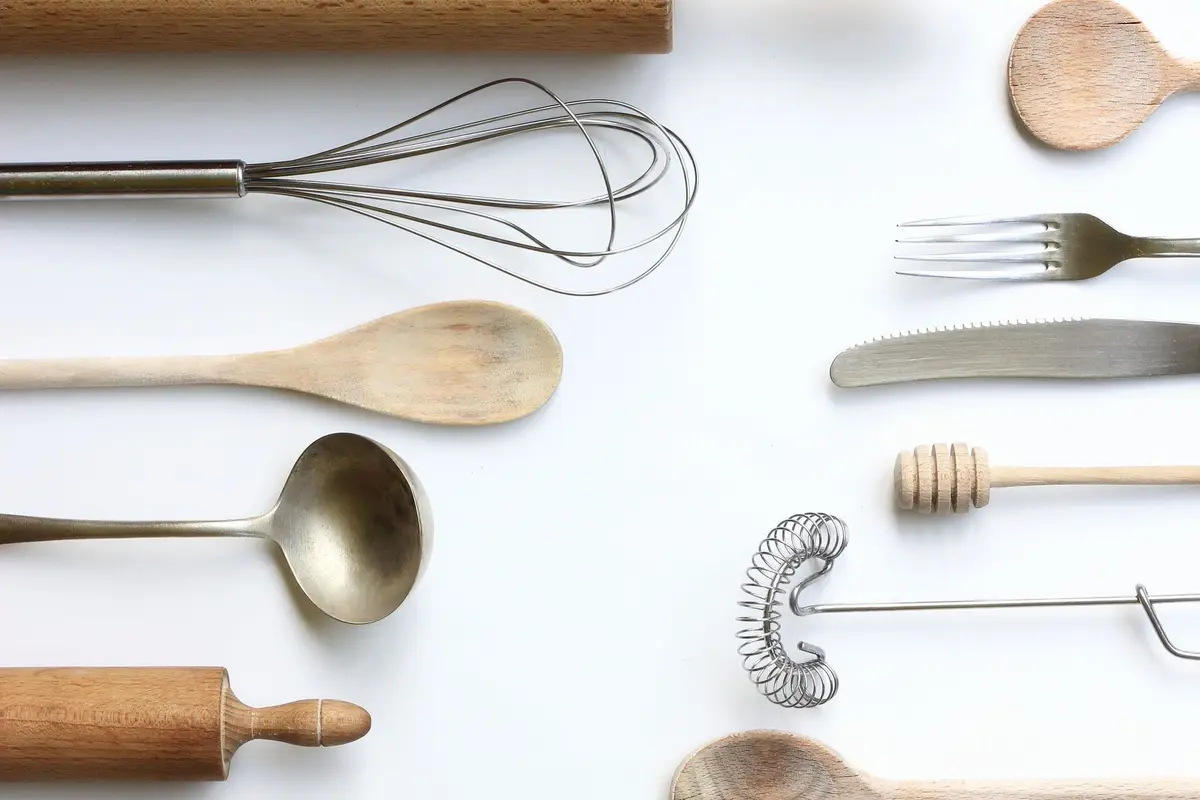
Be honest about what you use. Duplicate spatulas, the gadget that only does one thing, takeout chopsticks and bent whisks can go, and anything that belongs in another room goes back where it lives.
Work one drawer at a time, so the kitchen never ends up covered. The declutter checklist walks through the rest of the kitchen the same way, if the drawers are only the start.
Wipe each drawer while it’s empty. Crumbs, sticky spots and old rubber bands collect in the corners, and a clean, dry drawer is the right starting point for a liner or new dividers.
Keep a bag nearby for donations and a box for things that belong elsewhere. When the drawer is done, take both out of the kitchen right away, so nothing creeps back in.
2. Measure before you buy dividers
Measure the inside of each drawer: the width, the depth from front to back and the height from the bottom to the top of the sides. Write the numbers down, with a note on which drawer they belong to.
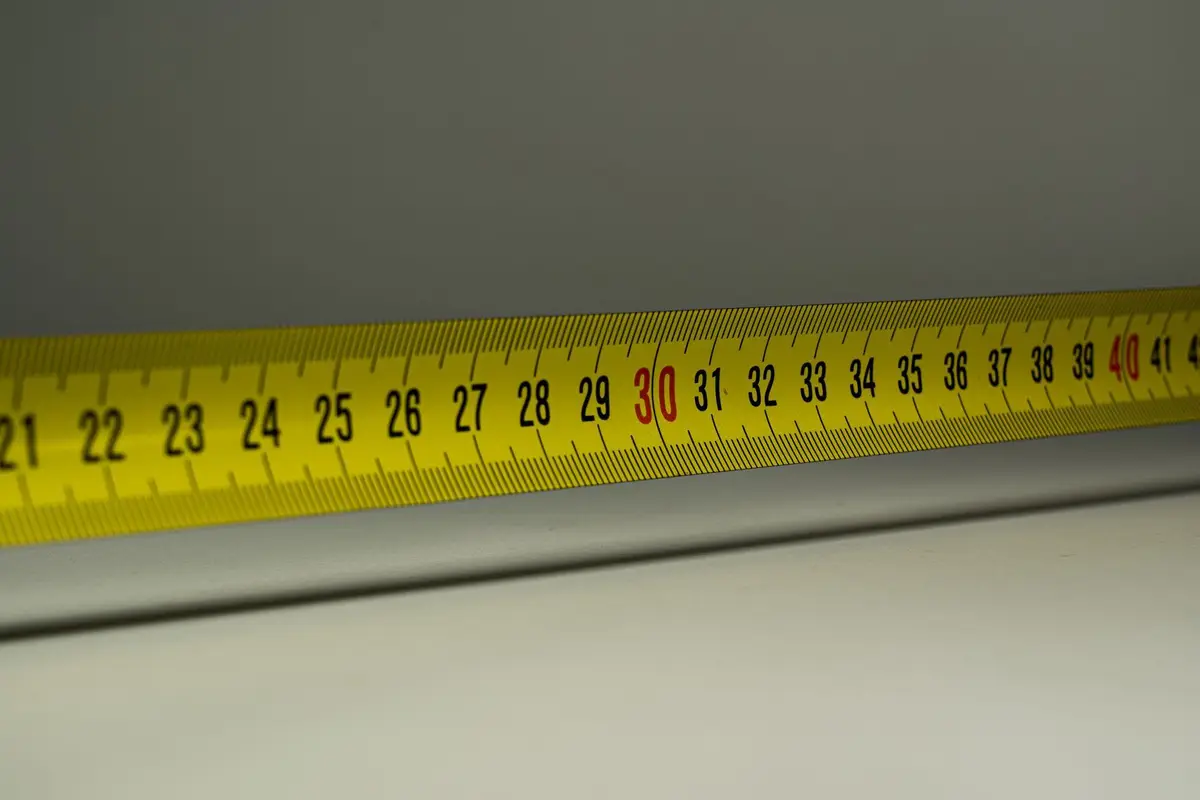
Drawers are smaller inside than they look from the front. The sides, the slides and the back panel all take up room, so measure the inside, not the drawer front.
Close the drawer and check what sits above it, too. A tall utensil or a bin with high sides can catch on the counter frame and stop the drawer from closing.
Take the numbers shopping, or enter them into the bin and basket size calculator to see which organizer sizes fit and how many line up side by side. It saves the trip back to return a tray that’s a little too long.
Measure in a few spots and use the smallest number, since older drawers aren’t always square. Note anything that cuts into the space, like a center rail, a handle screw or a lip at the back.
3. Give flatware a cutlery tray
A cutlery tray gives forks, knives and spoons a slot each, so they stop sliding into a pile. It’s the one organizer almost every kitchen needs, and it goes in the drawer closest to the dishwasher or the dish rack.
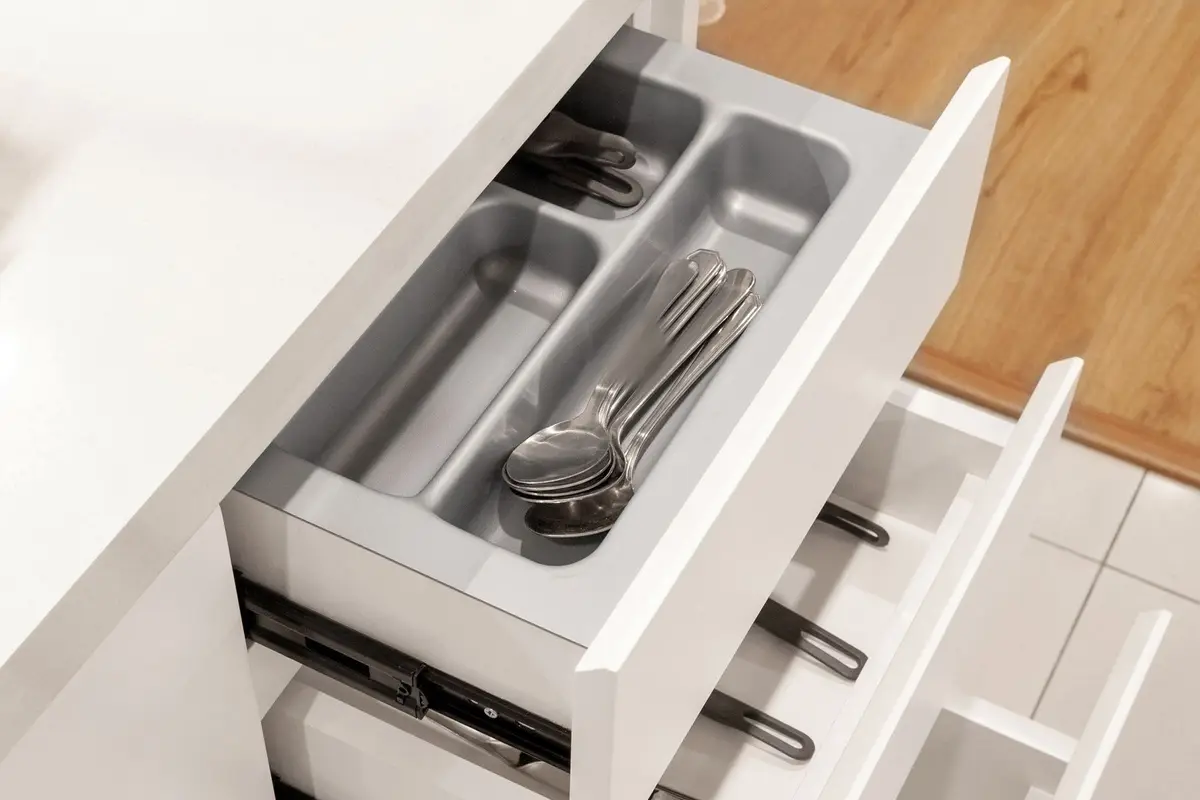
Pick a tray that fills the drawer from side to side. If there’s a gap at the edges, the tray shifts every time the drawer opens, and small things fall down beside it.
Expandable trays slide wider to fit the drawer, which helps when the measurements fall between standard sizes. A tray with an extra row holds serving spoons, a pie server or the kids’ smaller flatware.
Put the pieces you use most in the front slots and the extras toward the back. Steak knives and seldom-used serving pieces can go in a second tray in a lower drawer.
Unloading goes faster when the drawer sits right next to where clean dishes come out. Everyone in the house can put flatware away without asking where it goes, and the tray shows at a glance when something is missing.
4. Use adjustable dividers for odd-size tools
Spatulas, whisks, tongs and ladles don’t fit the slots of a cutlery tray. Adjustable dividers, either spring-loaded bars that press against the drawer sides or small bins you can move around, make lanes sized for the tools you actually own.
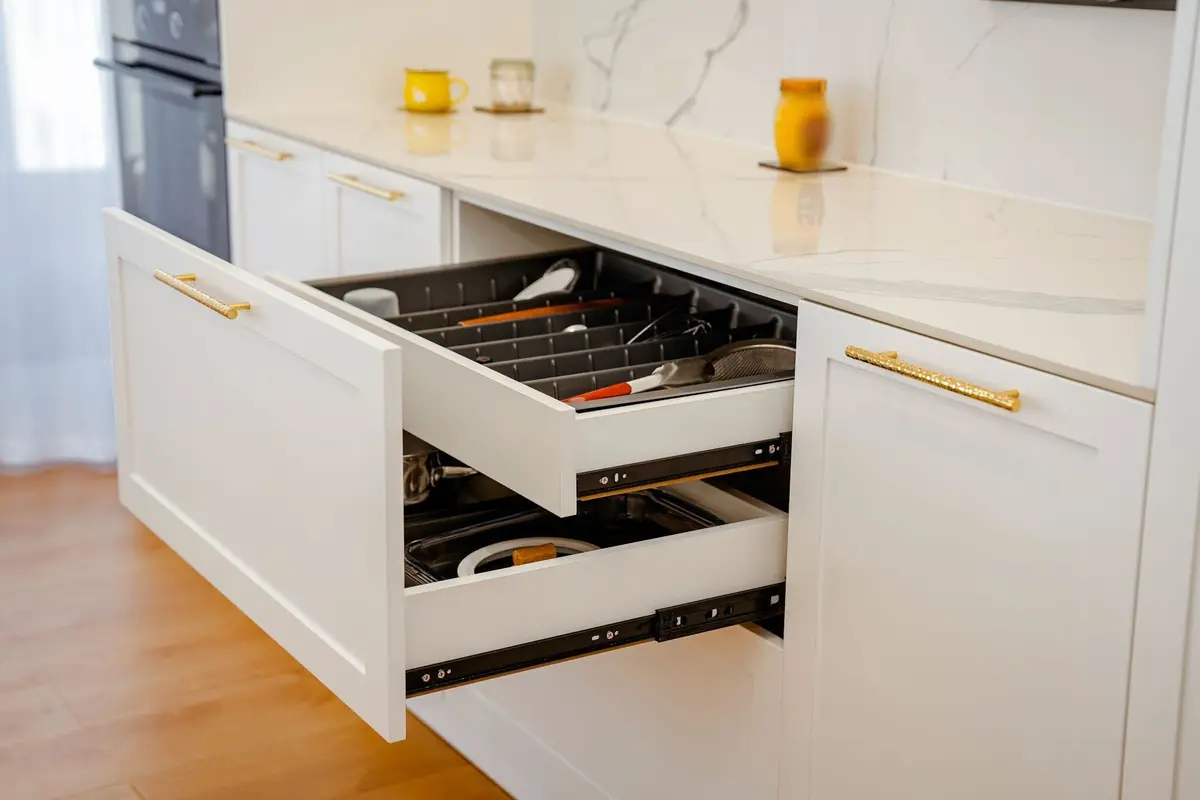
Run the dividers from front to back, so each lane holds one kind of tool lying flat. A long lane for spatulas, another for whisks and a short one for small gadgets keeps everything visible when the drawer opens.
Lay out the tools on the counter in the shape of the drawer before you set the dividers. You’ll see how wide each lane needs to be, and whether everything fits.
Spring-loaded dividers need no tools and move easily, so they suit a rental. Small bins in a few sizes work in shallow drawers, where a divider bar would sit too high.
Leave a little space in each lane. A drawer packed to the edges jams, and the tool you need ends up under all the others.
5. Keep cooking tools in the drawer by the stove
Store the tools you cook with in the drawer nearest the stove: spatulas, tongs, ladles, wooden spoons, a whisk and pot holders. You can reach them without walking across the kitchen while something is on the heat.
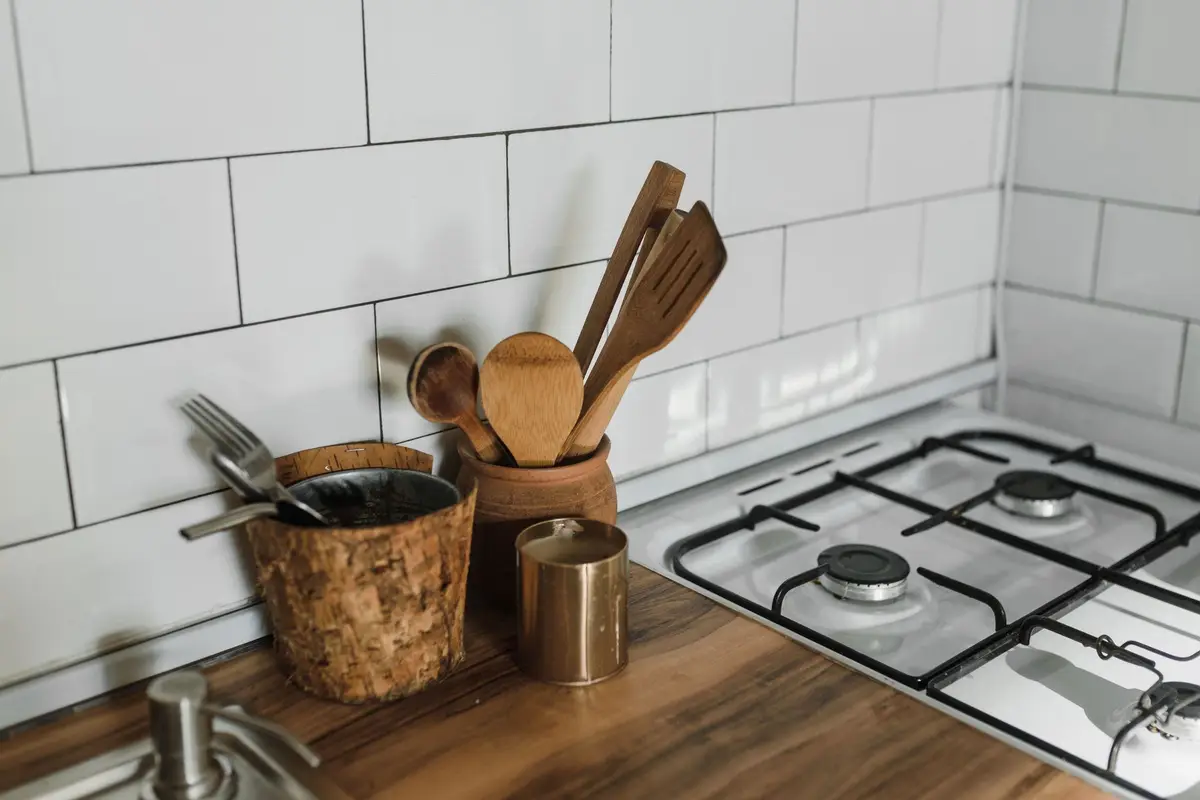
Sort the rest of the drawers by task, too. Baking tools go near the mixing bowls, prep tools like peelers and graters go near the cutting board, and serving pieces go near the dishes.
If the stove drawer is full, move the tools you use every day into a crock on the counter beside the stove. Long-handled spoons and spatulas stand up neatly, and the drawer keeps the smaller tools.
Keep only one or two of each tool in the stove drawer. Extras can go in a lower drawer or a cabinet, so the daily set never gets buried.
Pot holders and a trivet fit at the back of the same drawer. Folded flat, they’re right there when a hot pan comes off the burner, and they don’t take up a whole drawer of their own.
6. Give knives a block or a drawer insert
A loose knife in a drawer is a cut waiting to happen for the next hand that reaches in. Keep every blade covered: a knife block on the counter, an in-drawer knife insert that holds each knife in its own slot, or a plastic cover over each blade.
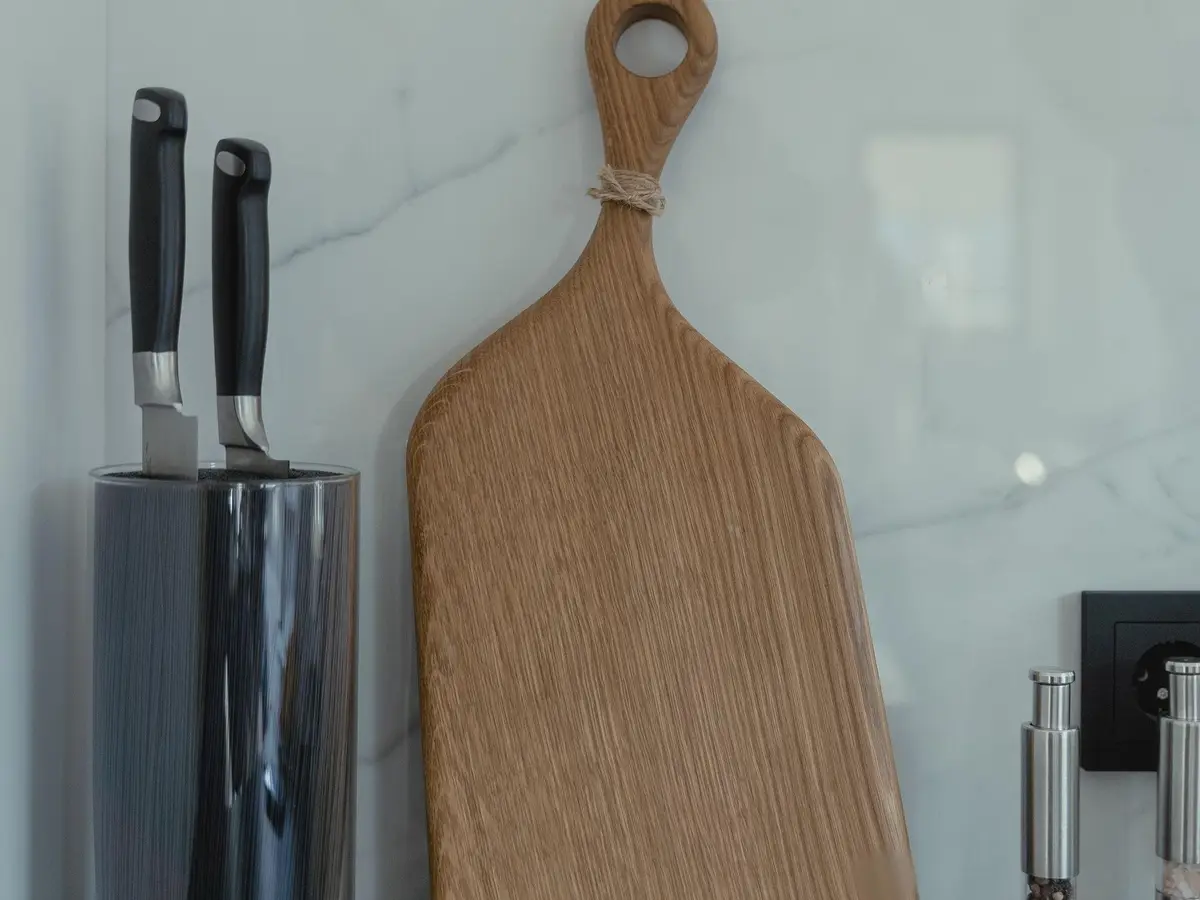
A drawer insert keeps knives off the counter, which helps in a small kitchen. Measure the drawer depth first, since a long chef’s knife needs a full-depth insert.
A magnetic strip on the wall is another option for steel knives. Hang it away from the edge of the counter, where an elbow or a towel could knock a knife loose.
Store knives out of reach of young children, or in a drawer with a childproof latch. The knife drawer shouldn’t be the one kids open for snacks or flatware.
Make sure each knife is clean and completely dry before it goes back. Putting a knife away wet can make it rust, and moisture trapped in a block or an insert takes a long time to dry.
7. Use deep drawers for pots, plates and bowls
Deep bottom drawers hold heavy things better than a high cabinet does. Pots, pans, plates, bowls and mixing bowls lift straight up and out, with no reaching or bending into the back of a low shelf.
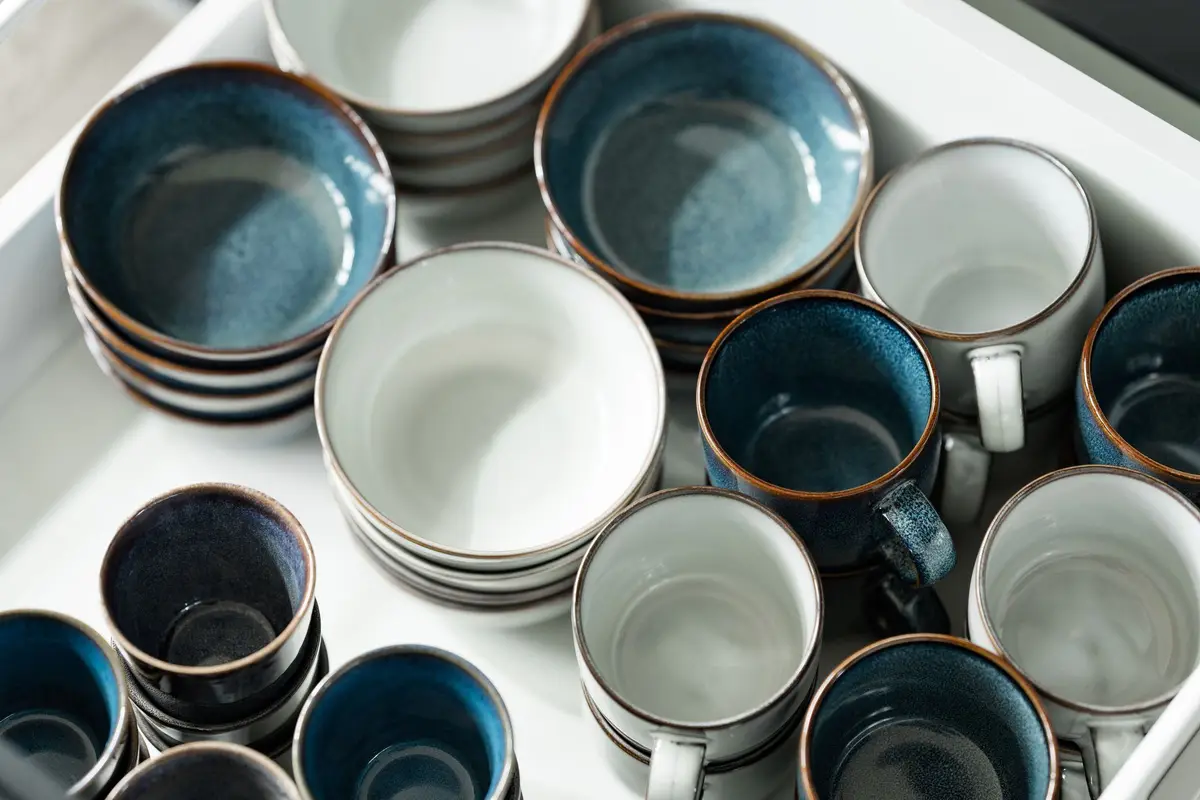
Stack plates and bowls in short piles, so each pile is easy to lift. Put the pieces you use every day in front, where you can grab one without moving the others.
A pegboard drawer insert keeps stacks of plates from sliding when the drawer opens and closes. The pegs move into new holes as your dishes change, so it works for plates, bowls and pots of different sizes.
Store pots with their lids flipped upside down on top, or stand the lids up on their edges along the side of the drawer. Nest pans from largest to smallest and slip a soft cloth between nonstick pans to protect the coating.
Keep the heaviest pieces at the back and the lightest at the front. The drawer opens more easily, and you don’t lift a heavy pot over everything else.
8. Lay spices flat in a spice drawer
A shallow drawer near the stove makes a good spice drawer. Jars lie on their sides with the labels facing up, so you can read every one at a glance instead of moving jars around to find the one at the back.

Tiered drawer inserts tilt the jars up at an angle, which makes the labels easier to read. A simple insert with grooves keeps round jars from rolling every time the drawer opens.
Matching jars line up neatly and use the space well. If you refill your spices into your own jars, the free spice jar labels put a clear name on each lid or front.
Heat, light and moisture fade the color and flavor of dried spices, so keep them in tightly closed jars in a dark drawer. Choose one to the side of the stove, and skip the drawer right above the dishwasher.
Sort them the way you cook: by cuisine, by how often you use them or in alphabetical order. Whichever you choose, keep it the same, so everyone in the house knows where to look and where to put a jar back.
9. Tame the junk drawer with small boxes
Every kitchen has a junk drawer, and that’s fine. It works when each kind of small item has its own little box: batteries, rubber bands, tape, a pen, scissors, twist ties and spare keys.
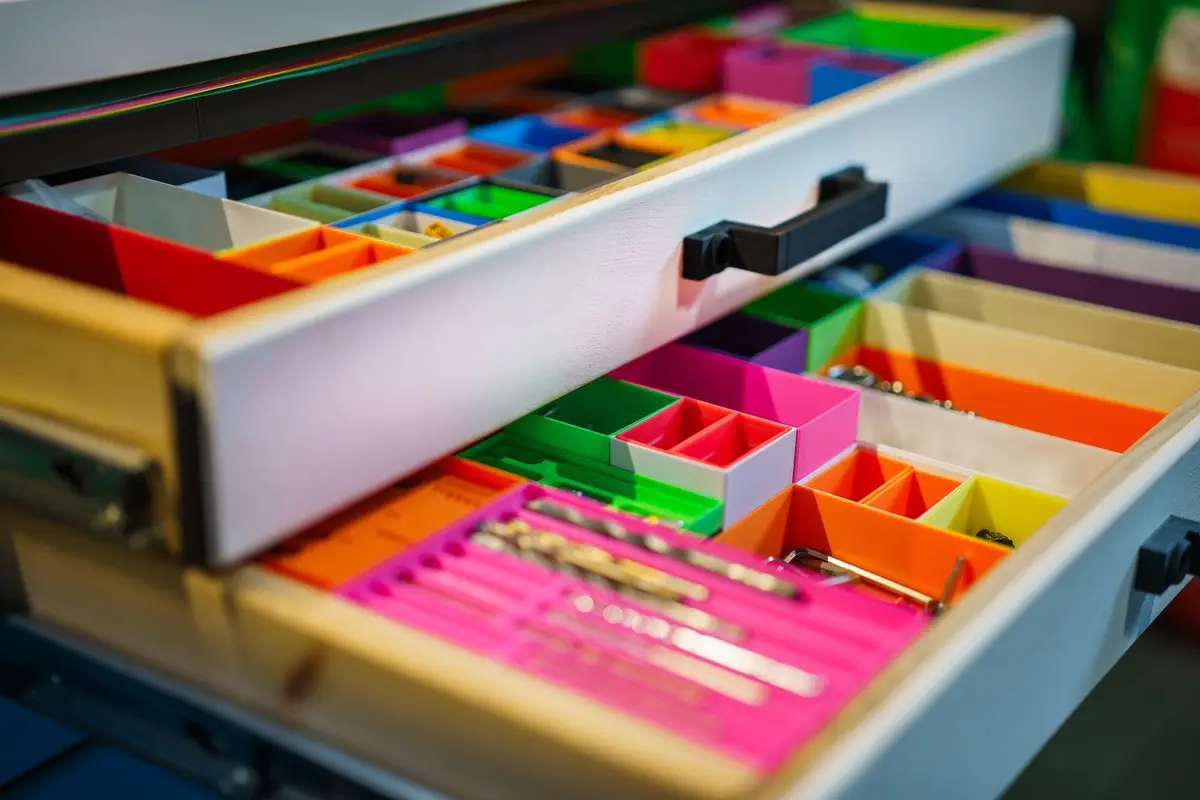
Small bins in a few sizes fit together like puzzle pieces. Shoe boxes, small food containers and clean jar lids work too, if you’d rather use what you already have.
Clear the junk drawer out first, the same way as the others. Old receipts, dried-up pens, takeout menus and mystery keys can go, and anything that belongs in the office or the garage moves there.
Keep a small pad of the printable grocery list and a pen in this drawer. When someone uses the last of something, the list is right there to write it down.
Give the junk drawer a quick tidy every few weeks. Five minutes of putting things back in their boxes keeps it from turning into a pile again.
10. File wraps and bags upright
Boxes of foil, plastic wrap, parchment paper and food storage bags stack badly and slide around. Stand the boxes up on their long edges in a drawer, side by side like files, so you can see every one and pull out the box you need.
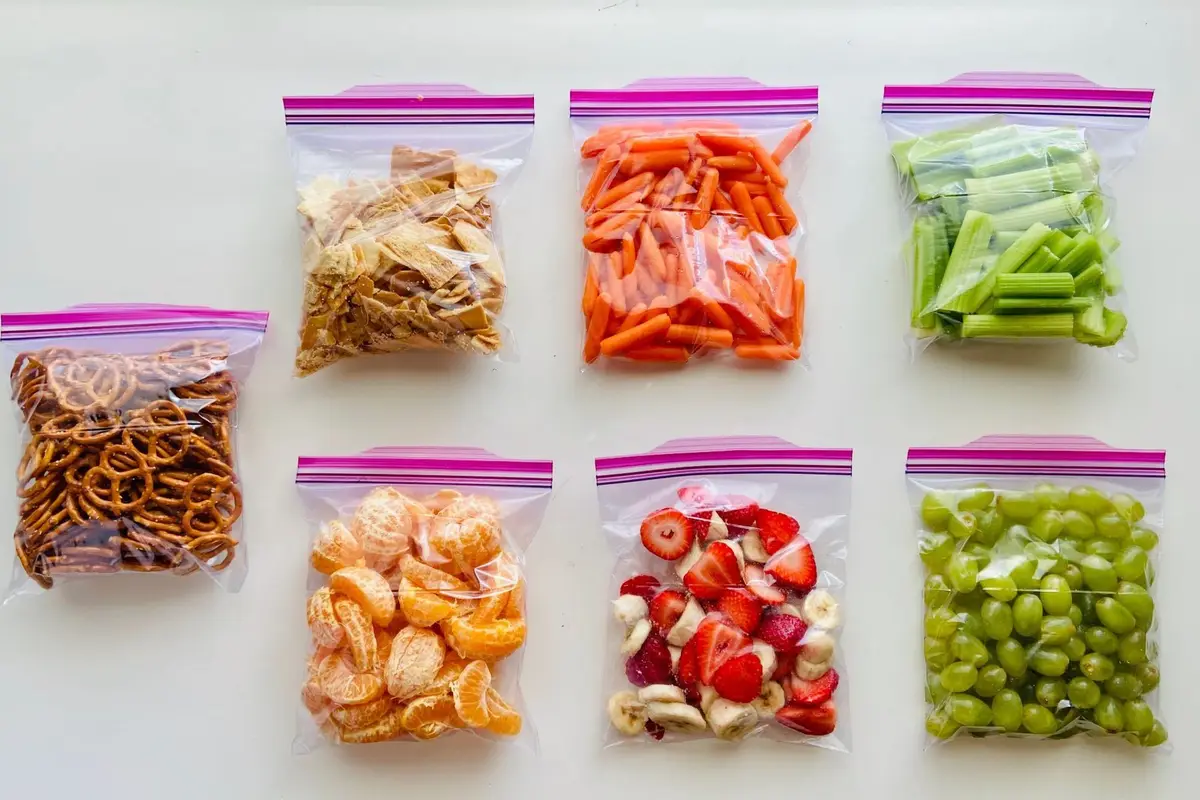
A drawer just deep enough for the boxes works best, since they can’t tip over. A divider or a bookend at the end of the row holds them up when the drawer isn’t full.
Group them by use: wraps together, bags together, smallest to largest. Lunch-packing supplies can go in the same drawer, so packing lunches happens in one spot.
Keep only one open box of each kind in the drawer. Backups can go with the pantry extras, or wherever you store bulk paper goods.
When you open the last box of something, add it to your shopping list right away. That way you never pull out an empty box when you’re trying to wrap leftovers.
11. Roll dish towels
Rolled dish towels take less room than folded stacks, and you can see every one when the drawer opens. Roll each towel tightly and stand the rolls in a row, or lay them side by side like logs.
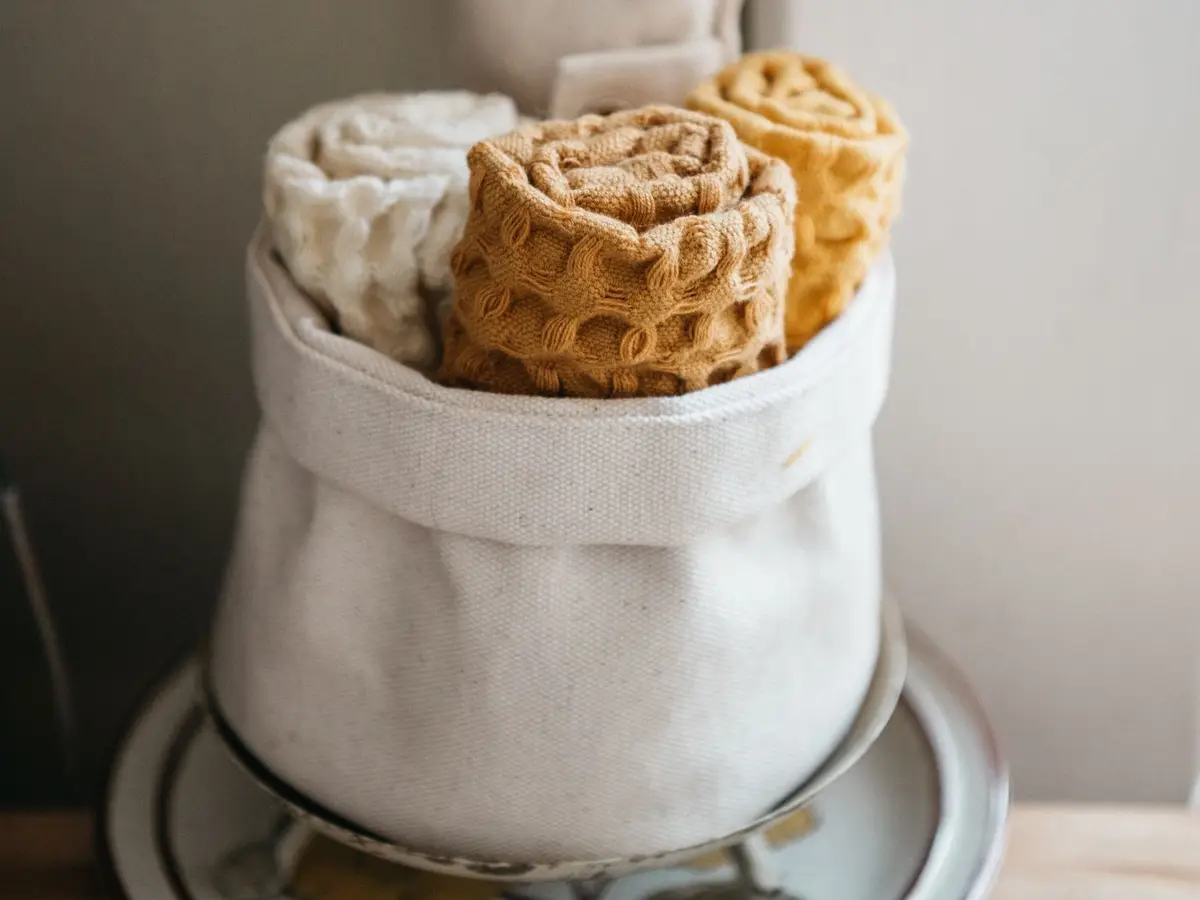
Keep dish towels, cloth napkins and cleaning cloths in their own lanes, so the good napkins don’t get used for spills. A shallow bin or a divider keeps the rows straight.
Count how many towels you actually use between laundry days and keep about that many, plus a few spares. Worn or stained towels can move to the rag bin for cleaning jobs.
Put the towel drawer near the sink, where wet hands and spills happen. A drawer next to the dishwasher works well, too. Even a narrow drawer works, since rolls fit into spaces a folded stack can’t.
Make sure towels are completely dry before you roll them. Damp towels packed into a closed drawer start to smell musty, and the smell spreads to the clean ones.
12. Add a non-slip liner
A non-slip liner keeps trays, dividers and loose items from sliding every time a drawer opens. It also protects the drawer bottom from scratches, drips and crumbs, and it’s easy to lift out and wipe.
Cut the liner to the inside measurements of each drawer, with a little trimmed off so it lies flat without curling up the sides. Sharp scissors and a straight edge give a clean cut.
Choose a liner you can wipe or rinse, especially for drawers that hold cooking tools or wraps. A grip liner with an open weave lets air move under damp items, and a smooth liner is easier to clean crumbs from.
Put the liner in before the trays and dividers go back. Then add the organizers, and each drawer is ready to load.
Lift the liners out and wash them when you do a deep clean. Let them dry fully before they go back into the drawer.
To keep it sorted, put things back in their own drawer and lane after every meal, and don’t add a new gadget without letting an old one go. A quick look through each drawer during a Sunday reset catches clutter early, and a full clean-out a few times a year starts again with the first idea.
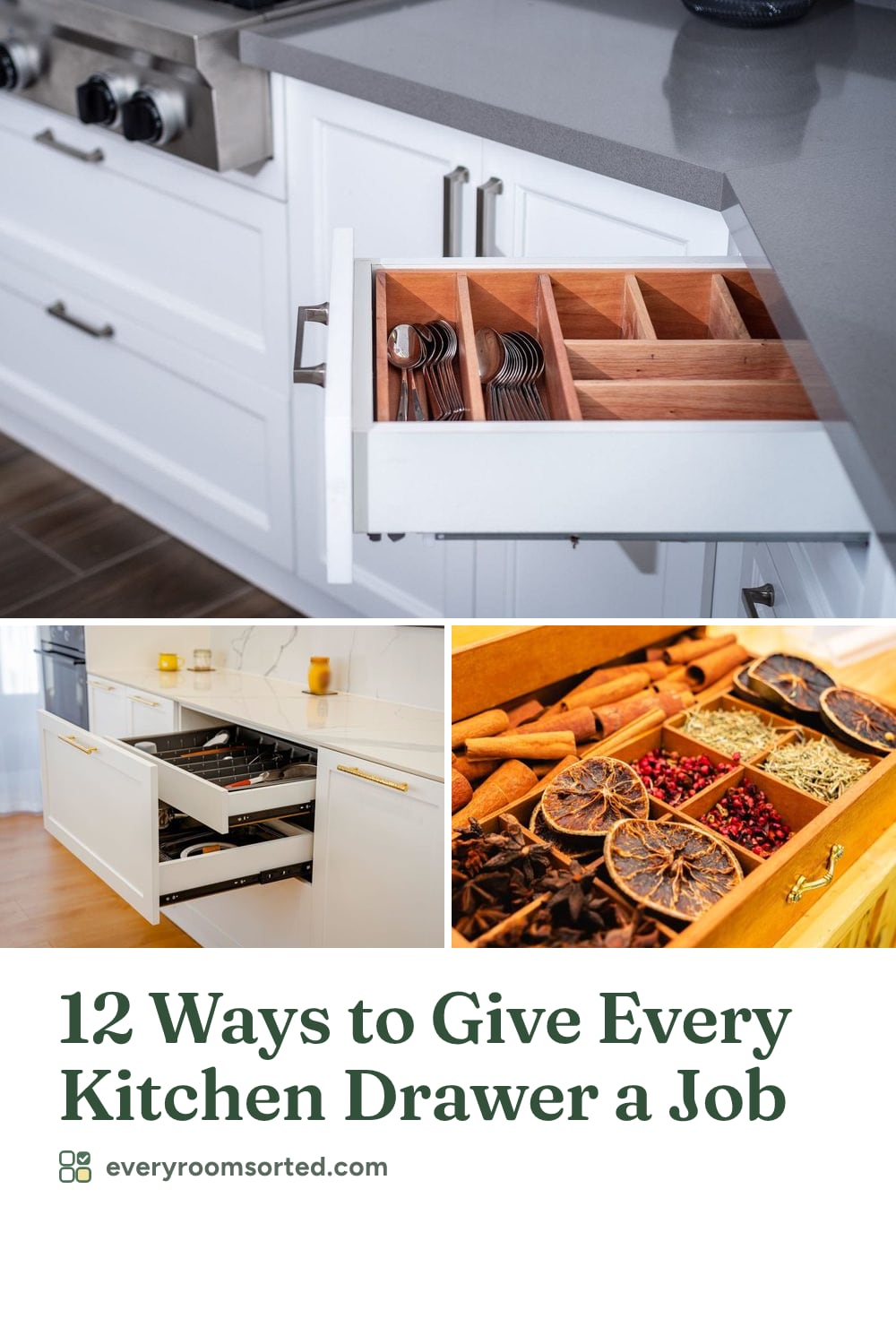
Save this for later
Pin it to a board so it's there when you're ready to start.
Save to Pinterest(opens in a new tab)Make it easier
Free printable
A one-page grocery list sorted by store section, with a box to tick for every item, so you write the list once and shop the store in one loop.
Free tool
Enter the width, depth and height of a shelf, a drawer or a cube cubby, and see which standard bins and baskets fit, how many, and how they line up.
Frequently asked questions
How do I organize kitchen drawers without buying anything?
Start by clearing out what you don't use, since an emptier drawer is easier to keep tidy. Then use what you already have as dividers: shoe boxes, mugs, jar lids and small food storage containers all work to keep each group in its own spot.
What should go in the top kitchen drawer?
The things you reach for every day, like flatware, a can opener, a peeler and the cooking tools you use most. Keep the top drawers for small, light items and save the deep bottom drawers for pots, pans and dishes.
Where should I keep knives if I don't have a knife block?
Use an in-drawer knife insert, a magnetic strip on the wall or a plastic cover over each blade, so no edge is ever bare where a hand might reach. Keep them out of reach of young children, and make sure each knife is clean and dry before you put it away.
How often should I clean out my kitchen drawers?
Give each drawer a quick tidy whenever it stops closing smoothly or you can't find something in a few seconds. A full clean-out a few times a year, where you empty, wipe and sort each drawer, keeps them from filling back up.